What Is Chemotherapy?
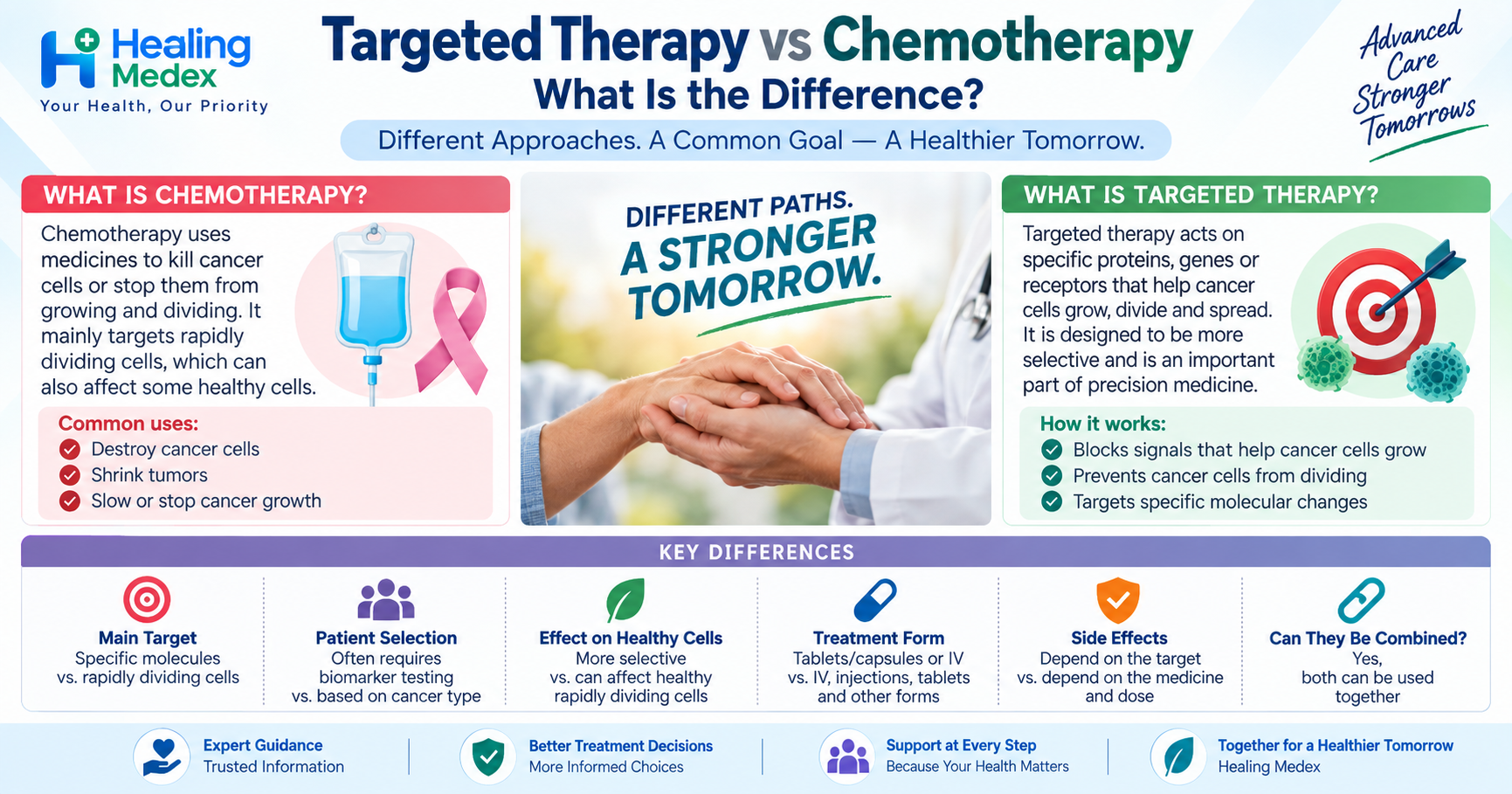
Chemotherapy, commonly called chemo, uses medicines to kill cancer cells or stop them from growing and dividing.
Cancer cells often grow and divide more rapidly than many normal cells. Chemotherapy takes advantage of this characteristic by attacking rapidly dividing cells. However, chemotherapy can also affect healthy cells that divide quickly, such as cells in the hair follicles, digestive system, and bone marrow.
Chemotherapy may be used to:
Destroy cancer cells
Shrink tumors
Slow or stop cancer growth
Reduce the chance of cancer returning after treatment
Make a tumor smaller before surgery or radiation
Relieve symptoms caused by advanced cancer
Depending on the cancer and medicine being used, chemotherapy may be given by an intravenous (IV) infusion, injection, tablets or capsules, or other routes.
What Is Targeted Therapy?
Targeted therapy is a type of cancer treatment designed to act on specific proteins, genes, receptors, or other biological features that help cancer cells grow, divide, and spread.
Unlike traditional chemotherapy, which generally attacks rapidly dividing cells, targeted treatments are designed around particular molecular characteristics of a person’s cancer. This is why targeted therapy is considered an important part of precision medicine.
Depending on the medicine, targeted therapy may:
Block signals that tell cancer cells to grow
Prevent cancer cells from dividing
Trigger cancer cell death
Block the formation of blood vessels that tumors need
Deliver cancer-killing substances directly to particular cells
Interfere with proteins or pathways cancer cells depend on
Most targeted therapies are either small-molecule drugs or monoclonal antibodies.
Targeted Therapy vs Chemotherapy: Key Differences
FeatureTargeted TherapyChemotherapy
Main targetSpecific molecules, proteins or changes involved in cancer growthMainly rapidly growing and dividing cells
How it works Blocks specific pathways or features cancer cells depend onKills cancer cells or prevents them from dividingPatient selectionOften requires biomarker or molecular testingUsually selected according to cancer type, stage and treatment planEffect on healthy cellsDesigned to be more selectiveCan also damage rapidly dividing healthy cellsTreatment formTablets/capsules or IV medicines depending on the drugIV, injections, tablets/capsules and other formsSide effectsDepend heavily on the target and medicineDepend on the chemotherapy medicines and dosesResistanceCancer can sometimes develop resistance to the targeted drugCancer can also become resistant to chemotherapy
Can treatments be combined?
YesYes
The biggest difference is therefore what the treatment attacks. Chemotherapy mainly attacks cells that are rapidly dividing, while targeted therapy focuses on particular biological features that help certain cancer cells survive or grow.
How Does Chemotherapy Kill Cancer Cells?
Cells continuously go through a process known as the cell cycle, during which they grow and divide.
Many chemotherapy medicines interfere with different parts of this process.
Because cancer cells frequently divide rapidly and may be less capable of recovering from cellular damage, chemotherapy can destroy them or prevent them from continuing to multiply.
Unfortunately, some healthy cells also divide quickly. These include cells responsible for:
Hair growth
Blood cell production
The lining of the mouth
The digestive tract
Damage to these healthy cells explains many of the familiar side effects associated with chemotherapy.
How Does Targeted Therapy Attack Cancer?
Researchers have identified numerous genes, proteins, receptors and signaling pathways involved in this process.
Targeted medicines are designed to interfere with specific abnormalities.
For example, a targeted therapy might block a protein sending signals that encourage cancer cells to multiply. Another treatment could interfere with blood vessel formation, reducing the tumor’s ability to obtain nutrients.
Some monoclonal antibodies can attach to specific targets on cancer cells, while small-molecule medicines can enter cells and interfere with targets inside them.
Does Everyone With Cancer Qualify for Targeted Therapy?
No.
One of the most important differences between chemotherapy and targeted therapy is that targeted treatment usually requires the cancer to contain an appropriate biological target.
Doctors may therefore recommend biomarker testing, sometimes called molecular, genomic or tumor testing.
The test may look for:
Gene mutations
Abnormal proteins
Receptors
Gene rearrangements
Other biomarkers associated with cancer growth
If the appropriate target is present and a medicine has been developed against it, targeted therapy may be considered.
However, two people with the same general type of cancer may have different molecular characteristics and therefore receive different treatments.
Which Cancers Can Be Treated With Targeted Therapy?
Targeted therapies are available for a growing number of cancers, although they are not appropriate for every cancer or every patient.
They may be used in selected cases of cancers including:
Breast cancer
Lung cancer
Colorectal cancer
Leukemia
Melanoma
Liver cancer
Ovarian cancer
Prostate cancer
Thyroid cancer
Stomach cancer
Gastrointestinal stromal tumors
Whether targeted therapy is suitable depends on the cancer’s specific molecular characteristics, its stage, previous treatments, the patient’s overall condition, and other clinical factors.
Side Effects of Chemotherapy
Chemotherapy side effects vary considerably between medicines and between patients.
Possible side effects can include:
Fatigue
Nausea and vomiting
Hair loss
Mouth sores
Diarrhea or constipation
Reduced appetite
Low blood cell counts
Increased risk of infection
Easy bleeding or bruising
Peripheral neuropathy
Fertility problems
Not every chemotherapy medicine causes all of these effects, and two people receiving similar treatment may experience very different symptoms.
Modern supportive medicines and treatment strategies can also help prevent or manage many chemotherapy-related side effects.
Side Effects of Targeted Therapy
It is sometimes assumed that targeted therapy has no side effects because it is designed to target cancer more selectively. This is not correct.
Targeted therapies can still cause significant and occasionally serious adverse effects.
Depending on the specific medicine, possible effects include:
Diarrhea
Skin rash or dry skin
Fatigue
Liver problems
Mouth sores
Nail changes
Problems with bleeding or blood clotting
Changes in wound healing
Side effects vary according to the treatment and its molecular target.
Therefore, targeted therapy should not automatically be considered safer than chemotherapy. The risks and benefits of each treatment need to be evaluated individually.
Is Targeted Therapy Better Than Chemotherapy?
Neither treatment can simply be described as universally “better.”
The most effective treatment depends on factors such as:
Type of cancer
Cancer stage
Tumor location
Whether cancer has spread
Biomarker results
Previous cancer treatments
Overall health
Treatment goals
For a cancer driven by a specific target for which an effective medicine exists, targeted therapy may be particularly valuable.
For other cancers, chemotherapy may remain the preferred treatment.
In many situations, doctors use targeted therapy and chemotherapy together rather than choosing only one. Cancer treatment frequently involves combinations of systemic therapies, surgery, radiation therapy, or other approaches.
Can Cancer Become Resistant to Targeted Therapy?
Yes.
One challenge with targeted therapy is drug resistance.
Cancer cells can change over time. A molecular target may change so that a medicine can no longer bind to it effectively, or cancer cells may begin using another biological pathway to continue growing.
For this reason, targeted therapy may sometimes stop working after an initial response.
Doctors might then:
Perform additional biomarker testing
Change the targeted treatment
Use another targeted medicine
Add chemotherapy
Consider another type of cancer treatment
Resistance is one reason cancer treatment plans may change during the course of the disease.
Can Targeted Therapy and Chemotherapy Be Used Together?
Yes.
Targeted therapy and chemotherapy are not necessarily competing treatment options.
A cancer specialist may recommend:
Targeted therapy alone when the tumor has an actionable molecular target and targeted treatment is appropriate.
Chemotherapy alone when chemotherapy is expected to provide the greatest benefit.
Targeted therapy plus chemotherapy when combining the treatments may improve cancer control.
Other treatments, including surgery, radiation therapy, hormone therapy and immunotherapy, may also form part of the overall treatment plan.
How Do Doctors Decide Which Treatment to Use?
Cancer treatment is highly individualized.
Before recommending treatment, an oncology team may consider:
The exact cancer type
Cancer stage and grade
Whether the disease has spread
Pathology results
Biomarker or molecular test results
Previous treatment
Other medical conditions
Expected treatment benefits
Potential side effects
The patient’s goals and preferences
Patients should therefore avoid comparing their treatment plan directly with another person’s cancer treatment.
Even cancers arising in the same organ can behave differently at a molecular level.
Questions to Ask Your Oncologist
If you are deciding between different cancer treatments, useful questions may include:
What type and stage of cancer do I have?
Has my tumor been tested for biomarkers?
Does my cancer have a target that can be treated?
Why are you recommending chemotherapy or targeted therapy?
What is the goal of treatment?
How will the treatment be given?
How long might treatment continue?
What side effects should I expect?
How will we know whether the treatment is working?
What happens if the cancer stops responding?
Are other treatment options available?
Having these discussions can make it easier to understand both the expected benefits and potential risks of treatment.
Targeted Therapy vs Chemotherapy: The Bottom Line
The main difference between targeted therapy and chemotherapy is how they attack cancer.
Chemotherapy primarily works by killing or stopping rapidly dividing cells. Because some healthy cells also divide quickly, chemotherapy can affect both cancerous and healthy tissues.
Targeted therapy acts on specific genes, proteins, receptors or pathways that certain cancers use to grow and survive. Biomarker testing is therefore often needed to determine whether a targeted medicine is appropriate.
Neither treatment is automatically better for every patient.
Depending on the cancer, doctors may recommend chemotherapy, targeted therapy, both treatments together, or another treatment approach entirely.
Cancer treatment should always be selected by an oncologist based on the patient’s individual diagnosis, tumor characteristics and overall health.
Frequently Asked Questions
1. Is targeted therapy the same as chemotherapy?
No. Both are cancer treatments, but they work differently. Chemotherapy generally attacks rapidly dividing cells, while targeted therapy acts on specific molecular features or pathways involved in cancer growth.
2. Does targeted therapy cause hair loss?
Some targeted treatments can affect the hair, but hair loss is not inevitable. Side effects depend on the particular medicine and target.
3. Does targeted therapy have fewer side effects than chemotherapy?
Not necessarily. Targeted therapies are more selective, but they can still cause significant side effects. The type and severity of side effects differ between individual medicines.
4. How do doctors know whether targeted therapy will work?
Biomarker testing is often performed to determine whether cancer cells contain a molecular feature that a targeted medicine can attack.
5. Can targeted therapy cure cancer?
The treatment goal varies according to the cancer type, stage and response. In some situations treatment may be given with curative intent; in others it is used to shrink, control or slow cancer and relieve symptoms.
6. Can chemotherapy and targeted therapy be taken together?
Yes. Some cancer treatment plans combine targeted therapy with chemotherapy when doing so is considered appropriate.
7. Which treatment is better for advanced cancer?
There is no single answer. Treatment depends on the type of cancer, molecular characteristics, previous treatments, overall health and other factors. An oncologist can determine the most appropriate approach.