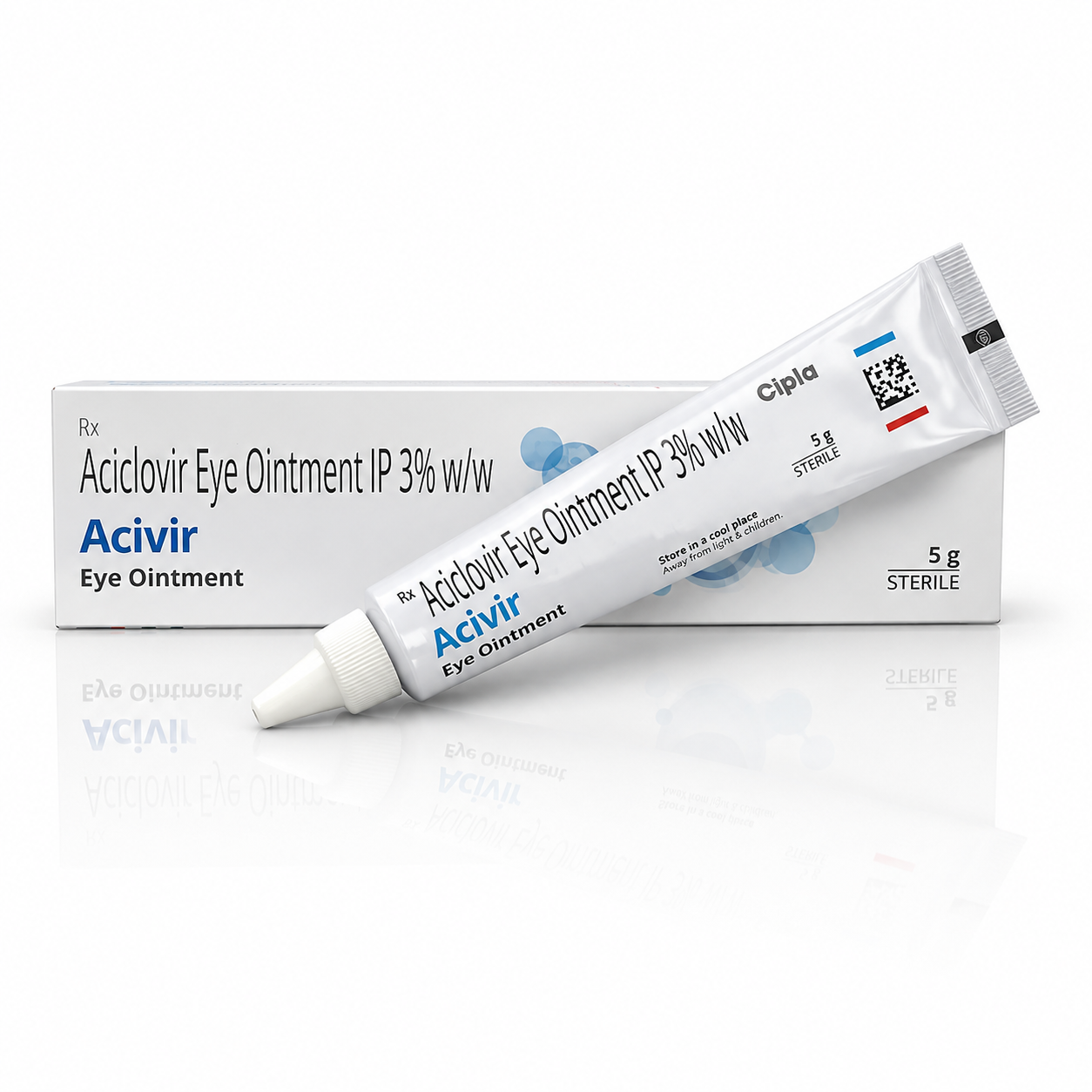
Acivir Eye Ointment 5 GM
$2.00 / unit
Available Options
| Pack Size | Price | Price / Unit | Quantity | Action |
|---|---|---|---|---|
| 10 Ointment | $15.00 | $1.50/unit | ||
| 8 Ointment | $12.00 | $1.50/unit | ||
| 6 Ointment | $9.00 | $1.50/unit | ||
| 4 Ointment | $6.00 | $1.50/unit | ||
| 2 Ointment | $4.00 | $2.00/unit | ||
| 1 Ointment | $2.00 | $2.00/unit |
Product Description
What is this medicine?
ACIVIR EYE OINTMENT contains Aciclovir (Acyclovir) 3% w/w and is manufactured/marketed by Cipla Ltd. It is a sterile antiviral ophthalmic ointment supplied in a 5 g tube. Cipla’s prescribing information also lists benzalkonium chloride 0.01% w/w in the formulation.
Aciclovir is an antiviral medicine that inhibits herpes simplex virus replication. Acivir Eye Ointment is specifically indicated for acute herpetic keratitis (dendritic corneal ulcers) caused by herpes simplex virus types HSV-1 and HSV-2.
This medicine is commonly used for:
herpes simplex infection of the cornea
acute herpetic keratitis
dendritic corneal ulcers caused by HSV-1 or HSV-2
controlling multiplication of herpes simplex virus in the affected eye
This medicine is intended only for ophthalmic (eye) use.
What should I tell my health care provider before I use this medicine?
They need to know if you have any of these conditions:
allergy to aciclovir or acyclovir
allergy to valaciclovir or valacyclovir
allergy to any ingredient in the eye ointment
previous allergic reaction to antiviral medicines
severe eye pain
worsening redness or inflammation
another eye infection
eye injury or recent eye surgery
any other serious eye disorder
if you normally wear contact lenses
if you use other prescription or non-prescription eye medicines
pregnancy or plans to become pregnant
breast-feeding
Aciclovir ophthalmic ointment is contraindicated in patients with known hypersensitivity to aciclovir, valaciclovir, or formulation ingredients.
How should I use this medicine?
Use Acivir Eye Ointment exactly as directed by your ophthalmologist or health care professional.
Cipla's prescribing information recommends applying approximately a 1 cm ribbon of ointment into the lower conjunctival sac (lower eyelid pocket) of the affected eye 5 times daily, approximately every 3 hours while awake, until the corneal ulcer heals. After healing, treatment is continued with a 1 cm ribbon 3 times daily for another 7 days. Follow your doctor's individual instructions.
To apply the ointment:
wash your hands thoroughly before application
tilt your head backward
gently pull down the lower eyelid to make a small pocket
apply the prescribed ribbon of ointment into this pocket
do not touch the eye, eyelid, fingers, or other surfaces with the tube tip
close the eye gently for about 1–2 minutes after application
wipe away excess ointment carefully
replace the cap securely
wash your hands after application
Do not stop treatment early simply because your eye begins to feel better. Complete the treatment duration prescribed by your doctor.
Do not wear contact lenses during treatment with Acivir Eye Ointment.
Overdosage: If you accidentally use substantially more than prescribed, or if the ointment is accidentally swallowed, contact your doctor or poison control center for advice. If severe eye irritation develops, seek medical attention.
NOTE: This medicine is only for you. Do not share this medicine with others.
What if I miss a dose?
If you miss an application, use it when you remember unless it is nearly time for your next scheduled application.
If it is almost time for the next dose, skip the missed application and continue with your regular schedule.
Do not apply a double or excessive amount of ointment to make up for a missed dose.
Try to use the medicine at regular intervals because consistent antiviral treatment is important for controlling the eye infection.
What may interact with this medicine?
Clinically significant systemic drug interactions are unlikely with aciclovir eye ointment because it is applied locally to the eye. However, tell your health care provider about all medicines you use, especially:
other antiviral medicines
other prescription eye drops
antibiotic eye preparations
corticosteroid eye drops or ointments
anti-inflammatory eye medicines
lubricating/artificial-tear products
other ophthalmic ointments
If you need to use more than one eye medicine, ask your doctor or pharmacist how much time to leave between products and which product should be applied last.
This list may not describe all possible interactions. Give your health care provider a complete list of prescription medicines, non-prescription drugs, herbs, vitamins, and dietary supplements you use.
What should I watch for while using this medicine?
Your eye infection should be monitored by a doctor or ophthalmologist. Herpes simplex keratitis involves the cornea and can potentially affect vision, so use the medicine for the full prescribed treatment period.
Temporary mild stinging or discomfort immediately after application can occur.
Contact your doctor promptly if:
eye pain develops or becomes worse
redness becomes worse
itching or inflammation increases
your vision becomes significantly worse
swelling develops around the eye
symptoms fail to improve
symptoms return after treatment
Do not allow the tip of the tube to touch your eye, eyelid, fingers, or another surface. This can contaminate the sterile ointment and potentially cause an additional eye infection.
Do not wear contact lenses while you have signs or symptoms of herpetic keratitis or while undergoing treatment with this medicine.
The ointment may temporarily blur your vision after application. Wait until your vision is clear before driving, operating machinery, or performing activities requiring clear eyesight.
What side effects may I notice from this medicine?
Side effects that you should report to your doctor or health care professional as soon as possible:
severe or persistent eye pain
worsening eye redness
severe eye irritation
significant swelling around the eye
worsening inflammation
marked visual disturbance
severe itching
signs of an allergic reaction
swelling of the face, lips, eyelids, or tongue
difficulty breathing or swallowing
Side effects that usually do not require medical attention (report them if they continue or are bothersome):
temporary mild stinging after application
mild burning or eye discomfort
temporary blurred vision
eye irritation
eye redness
watery eyes
With aciclovir 3% ophthalmic ointment, reported adverse reactions include eye pain/stinging, punctate keratitis, and follicular conjunctivitis.
This list may not describe all possible side effects.
Where should I keep my medicine?
Keep out of the reach of children.
Cipla's prescribing information states that Acivir Eye Ointment should be stored well closed at a temperature not exceeding 25°C.
Keep the tube:
tightly closed when not in use
in its original packaging
protected from excessive heat
away from direct sunlight
away from contamination
Do not use the ointment after the expiration date printed on the package. Do not use it if the tube or seal appears damaged or contaminated.