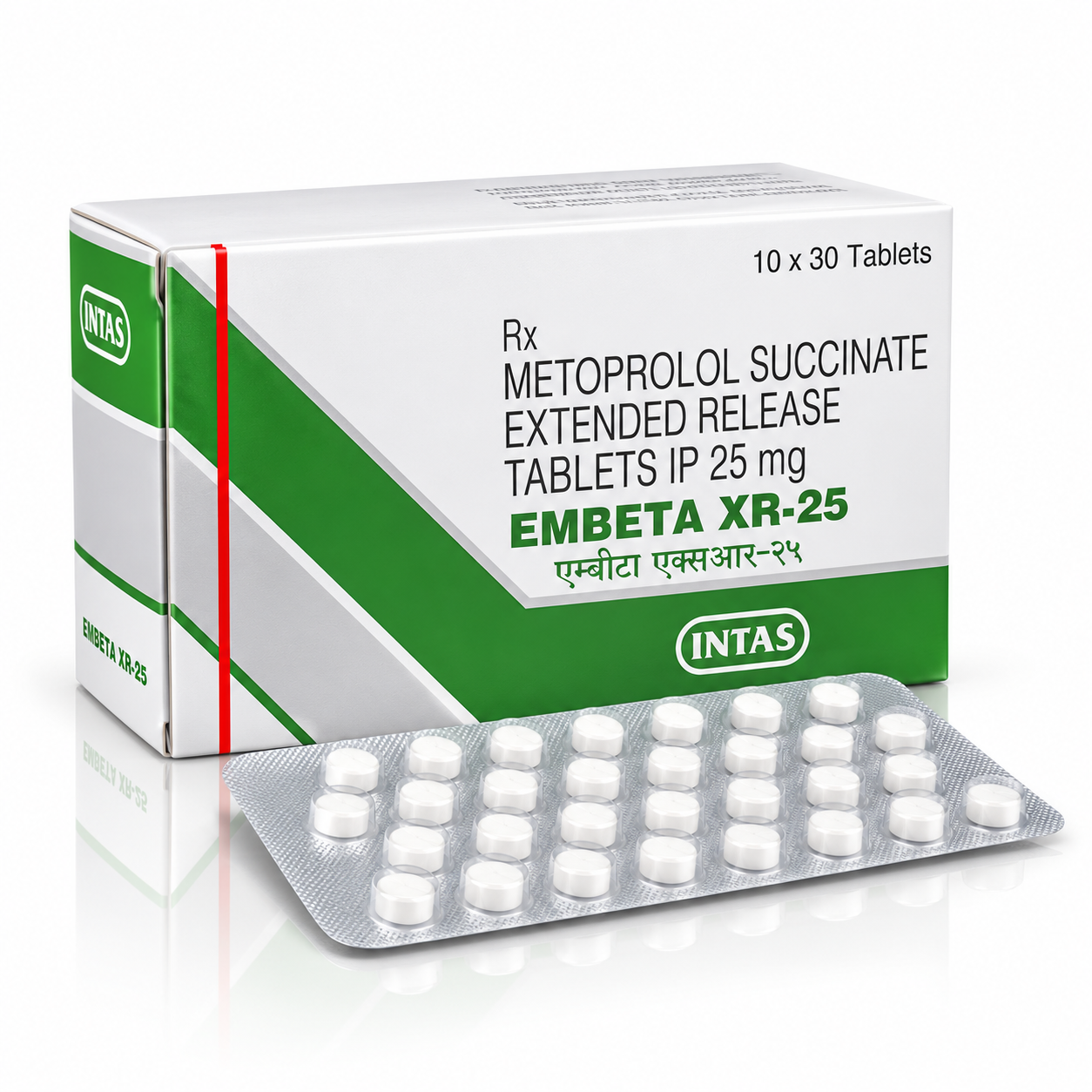
Embeta-XR 25 MG Tablet
$0.70 / unit
Available Options
| Pack Size | Price | Price / Unit | Quantity | Action |
|---|---|---|---|---|
| 180 Tablets | $97.00 | $0.54/unit | ||
| 150 Tablets | $83.00 | $0.55/unit | ||
| 120 Tablets | $68.00 | $0.57/unit | ||
| 90 Tablets | $54.00 | $0.60/unit | ||
| 60 Tablets | $39.00 | $0.65/unit | ||
| 30 Tablets | $21.00 | $0.70/unit |
Product Description
EMBETA-XR 25 MG Tablet
Brand Name: Embeta-XR 25 MG Tablet
Generic Name: Metoprolol Succinate
Active Ingredient: Metoprolol Succinate 23.75 mg
Labelled Strength: 25 mg
Dosage Form: Extended-Release Oral Tablet
Therapeutic Class: Antihypertensive / Antianginal / Cardiovascular Medicine
Pharmacological Class: Cardioselective Beta-1 Adrenergic Receptor Blocker
Manufacturer / Marketer: Intas Pharmaceuticals Ltd.
Pack Size: 1 × 30 Tablets
Country of Origin: India
Route of Administration: Oral
Prescription Status: Prescription Medicine
Composition
Ingredient | Strength / Description |
|---|---|
Metoprolol Succinate IP | 23.75 mg |
Equivalent Metoprolol Tartrate Strength | 25 mg |
Release Type | Extended Release (XR) |
Inactive Ingredients | As specified on the original product strip |
What is this medicine?
EMBETA-XR 25 MG TABLET contains metoprolol succinate, a cardioselective beta-blocker used to treat certain heart and blood pressure conditions.
Beta-blockers reduce the effects of stress hormones, including adrenaline and noradrenaline, on beta-adrenergic receptors.
Metoprolol acts mainly on beta-1 receptors located in the heart.
It helps lower heart rate, reduce the force of cardiac contraction and decrease the heart's workload.
How does Embeta-XR 25 work?
Metoprolol selectively blocks beta-1 adrenergic receptors in the heart.
These receptors normally respond to adrenaline and related hormones.
Their stimulation can increase:
Heart rate
Force of heart contraction
Cardiac workload
Oxygen demand
By reducing beta-1 receptor stimulation, metoprolol slows the heart rate and helps the cardiovascular system work more efficiently.
It also reduces renin release from the kidneys, which contributes to its blood pressure-lowering effects.
Main Effects
1. Helps Lower Blood Pressure
Metoprolol reduces cardiac output and influences mechanisms involved in blood pressure regulation.
2. Slows a Fast Heart Rate
It reduces the effects of adrenaline on the heart and may help control certain rapid heart rhythms.
3. Reduces the Heart's Workload
By lowering heart rate and contractility, it can reduce the heart muscle's oxygen requirements.
4. Helps Prevent Angina Episodes
Metoprolol may reduce episodes of chest pain caused by increased myocardial oxygen demand.
5. Supports Treatment of Selected Heart Failure Patients
Extended-release metoprolol succinate is one of the beta-blockers with established benefits in appropriate patients with chronic heart failure.
6. Provides Prolonged Action
The extended-release formulation is designed for approximately 24-hour dosing coverage, supporting once-daily administration.
Medical Uses
Embeta-XR 25 MG Tablet may be prescribed for:
Hypertension
Chronic stable angina
Stable chronic heart failure in appropriately selected patients
Certain heart rhythm disorders under specialist supervision
Selected patients requiring heart rate control
Other cardiovascular conditions when clinically justified
Is Embeta-XR Used for High Blood Pressure?
Yes.
Metoprolol can lower blood pressure and reduce cardiovascular workload.
However, beta-blockers are not necessarily the first-choice medicine for every patient with uncomplicated hypertension.
Selection depends on heart rate, existing cardiovascular disease and other clinical factors.
Can Embeta-XR Treat Angina?
Yes.
Metoprolol may reduce the frequency of chronic stable angina episodes.
By slowing the heart and reducing oxygen demand, it helps improve the balance between the heart muscle's oxygen supply and requirements.
It is not a rapid rescue medicine for sudden or severe chest pain.
Is Embeta-XR Used for Heart Failure?
Yes, in selected patients with stable chronic heart failure.
Metoprolol succinate extended-release has evidence supporting reduced cardiovascular mortality and heart-failure hospitalisation.
However, treatment should be initiated or increased carefully, especially in patients with fluid overload, low blood pressure or recent deterioration.
Can Embeta-XR Control Palpitations?
It may help control palpitations caused by certain rapid heart rhythms.
However, palpitations have multiple possible causes, and not every arrhythmia should be treated with metoprolol.
Diagnosis and ECG assessment may be necessary.
Is Embeta-XR Used for Migraine Prevention?
Metoprolol is sometimes prescribed for migraine prevention.
However, the specific use of Embeta-XR for migraine prevention should be regarded as dependent on local authorisation and clinical guidance.
It does not provide immediate relief from an active migraine attack.
Can Embeta-XR Prevent Heart Attacks?
Metoprolol may be used in selected patients with coronary artery disease or after myocardial infarction.
However, metoprolol succinate extended-release is not interchangeable with every immediate-release metoprolol regimen used around an acute heart attack.
Treatment following myocardial infarction requires a condition-specific medical plan.
Is Embeta-XR a Blood Thinner?
No.
Embeta-XR is a beta-blocker, not an anticoagulant or antiplatelet medicine.
It does not directly prevent blood clot formation.
Does Embeta-XR Cure Hypertension?
No.
It helps control high blood pressure but generally does not eliminate the underlying tendency toward hypertension.
Long-term treatment may be necessary.
Official metoprolol succinate extended-release prescribing information confirms its use for hypertension, angina and heart failure.
What should I tell my health care provider before I take this medicine?
Tell your healthcare provider if you have any of these conditions:
Allergy to metoprolol
Allergy to other beta-blockers
Very slow heart rate
Low blood pressure
Second- or third-degree heart block
Sick sinus syndrome
Heart failure that is worsening or unstable
Cardiogenic shock
Asthma
Chronic obstructive pulmonary disease
Diabetes mellitus
Frequent low blood sugar episodes
Overactive thyroid
Pheochromocytoma
Peripheral arterial disease
Raynaud's phenomenon
Significant liver disease
Kidney disease
Previous fainting episodes
Depression or significant fatigue
Pregnancy or plans to become pregnant
Breastfeeding
Planned surgery or anaesthesia
Current use of medicines that slow heart rate
Current use of other blood pressure medicines
Inform your healthcare professional about all prescription medicines, over-the-counter medicines, vitamins and herbal supplements.
Important Contraindications
Metoprolol succinate extended-release tablets should not be used in patients with:
Severe bradycardia
Second- or third-degree heart block without appropriate pacing
Cardiogenic shock
Decompensated heart failure
Sick sinus syndrome without a permanent pacemaker
Known serious hypersensitivity to the medicine or its ingredients
These contraindications are specified in the official prescribing information.
Important Slow Heart Rate Precaution
Metoprolol reduces heart rate.
A heart rate that becomes excessively slow may cause:
Dizziness
Weakness
Fatigue
Fainting
Reduced exercise tolerance
Patients should have their heart rate monitored according to medical advice.
Important Low Blood Pressure Precaution
Embeta-XR may lower blood pressure excessively in susceptible patients.
This can cause lightheadedness, weakness or fainting.
The risk may increase with other blood pressure-lowering medicines.
Important Heart Failure Precaution
Patients with stable heart failure may benefit from metoprolol succinate extended-release.
However, symptoms can temporarily worsen during treatment initiation or dose escalation.
Signs of deterioration include:
Rapid weight gain
Increasing ankle swelling
Worsening breathlessness
Difficulty breathing while lying flat
Unusual fatigue
These symptoms require prompt medical review.
Important Asthma and COPD Precaution
Metoprolol is relatively selective for beta-1 receptors, but this selectivity is not absolute.
Higher doses or individual sensitivity may lead to beta-2 receptor blockade and bronchospasm.
Patients with asthma or other bronchospastic diseases require particular caution.
Important Diabetes Precaution
Metoprolol can mask certain warning signs of hypoglycaemia, particularly a rapid heartbeat.
Patients with diabetes may need additional blood glucose monitoring.
Sweating and other low blood sugar symptoms may still occur.
Important Thyroid Precaution
Beta-blockers can mask symptoms of hyperthyroidism, including tachycardia.
Abrupt withdrawal in a patient with thyrotoxicosis may contribute to serious complications.
Important Liver Precaution
Metoprolol is metabolised mainly by the liver.
Patients with significant hepatic impairment may have increased exposure and require lower initial doses or slower dose adjustments.
Pregnancy Precautions
Metoprolol may be used in pregnancy when the treating clinician determines that the benefits outweigh the risks.
Exposure during pregnancy can be associated with fetal growth concerns or neonatal bradycardia and hypoglycaemia.
Pregnant patients require individualised medical assessment.
Breastfeeding Precautions
Metoprolol passes into breast milk in small quantities.
It is generally considered compatible with breastfeeding in appropriately selected patients, but monitoring may be recommended for signs of excessive beta-blockade in the infant.
Children's Precaution
Certain metoprolol succinate extended-release products have approval for hypertension in children aged six years and older under US prescribing information.
However, paediatric use of the Indian Embeta-XR product should follow its specific label and specialist prescribing guidance.
Do not administer the 25 mg tablet to a child without a prescription.
How should I use this medicine?
Take Embeta-XR 25 MG Tablet exactly as prescribed by your healthcare professional.
Instructions for Oral Administration
Confirm the prescribed medicine and 25 mg strength.
Swallow the extended-release tablet with water.
Take it once daily unless your prescriber instructs otherwise.
Take it consistently at approximately the same time each day.
Do not crush or chew the tablet.
Do not split the tablet unless the original product instructions permit it.
Monitor your blood pressure and pulse as advised.
Do not increase or decrease the dose independently.
Report unusual dizziness, excessive fatigue or a very slow heartbeat.
Never stop the medicine suddenly without medical advice.
Dosage Information
Dosage Detail | Reference Information |
|---|---|
Labelled Strength | 25 mg |
Active Ingredient | Metoprolol Succinate 23.75 mg |
Release Type | Extended Release |
Route | Oral |
Usual Frequency | Once daily |
Hypertension: Adult Reference Starting Dose | 25–100 mg once daily |
Chronic Stable Angina: Adult Reference Starting Dose | 100 mg once daily |
Stable Heart Failure: Reference Starting Dose | 12.5 mg or 25 mg once daily |
Heart Failure: Reference Target Dose | Up to 200 mg once daily, if tolerated |
Dose Adjustment | According to heart rate, blood pressure and response |
Treatment Duration | Often long-term |
These are reference doses for metoprolol succinate extended-release tablets, not instructions to begin treatment independently.
Reference Dose for Hypertension
For adults, established prescribing information describes a starting dose of 25–100 mg once daily.
The prescriber adjusts treatment according to blood pressure, heart rate and tolerability.
Reference Dose for Chronic Stable Angina
The standard adult reference starting dose is commonly 100 mg once daily.
However, clinicians may choose lower doses in selected patients when appropriate.
Reference Dose for Stable Heart Failure
For appropriately selected adults with stable symptomatic heart failure, treatment may begin with:
12.5 mg once daily in certain more symptomatic patients
25 mg once daily in other suitable patients
The dose is gradually increased, typically at intervals of about two weeks, if tolerated.
The reference target is up to 200 mg once daily.
Important: Initiation or dose escalation should be supervised by a healthcare professional familiar with heart failure treatment.
How Long Does Embeta-XR Take to Work?
Metoprolol begins to affect heart rate after absorption.
The blood pressure-lowering response may develop over days to weeks.
Stable long-term cardiovascular benefits depend on consistent treatment.
Can Embeta-XR Be Taken With Food?
Metoprolol succinate extended-release tablets can generally be taken with or without food.
The medicine should be taken consistently according to the prescriber's or product label's instructions.
Can Embeta-XR Be Taken in the Morning?
Yes.
Once-daily metoprolol extended-release is commonly taken in the morning, although the prescribing clinician may recommend another time.
Can Embeta-XR Tablets Be Split?
Certain metoprolol succinate extended-release tablets are scored and may be divided without altering their controlled-release characteristics.
However, splitting permission depends on the specific tablet formulation.
Do not assume Embeta-XR 25 can be split solely because another metoprolol extended-release brand permits this.
Can Embeta-XR Be Crushed?
No.
Extended-release metoprolol tablets should not be crushed or chewed.
Doing so may disrupt the intended release characteristics.
How Long Should Embeta-XR Be Taken?
Treatment duration depends on the condition.
Patients with hypertension, chronic angina or heart failure may require long-term therapy.
Do not stop the medicine because blood pressure or heart rate has improved.
Overdosage
Excessive metoprolol may cause:
Severe bradycardia
Very low blood pressure
Fainting
Heart block
Cardiogenic shock
Breathing difficulties
Seizures
Loss of consciousness
Suspected significant overdose is a medical emergency.
What if I miss a dose?
Take the missed tablet when remembered unless the next dose is nearly due.
If the next dose is approaching, skip the missed dose.
Do not double the next dose.
Resume the regular schedule.
Seek professional advice if several doses have been missed.
Important: Do not abruptly interrupt long-term beta-blocker treatment without medical supervision.
What may interact with this medicine?
Potentially important medicines include:
Verapamil
Diltiazem
Digoxin
Clonidine
Amiodarone
Other beta-blockers
Fluoxetine
Paroxetine
Bupropion
Quinidine
Terbinafine
Certain antiarrhythmic medicines
Other antihypertensive medicines
Insulin
Certain antidiabetic medicines
Medicines affecting CYP2D6 metabolism
Important Drug Interaction Considerations
Verapamil and Diltiazem
These calcium channel blockers can slow cardiac conduction and heart rate.
Combining them with metoprolol may increase the risk of bradycardia, low blood pressure or heart block.
Digoxin
Digoxin and metoprolol can have additive heart-rate-slowing effects.
Clonidine
Combined treatment may cause bradycardia or hypotension.
Abruptly withdrawing clonidine while taking a beta-blocker may produce severe rebound hypertension.
Any medication changes require professional planning.
Amiodarone
May increase the risk of slow heart rate and cardiac conduction abnormalities.
Fluoxetine and Paroxetine
These antidepressants inhibit CYP2D6, an enzyme involved in metoprolol metabolism.
They may increase metoprolol concentrations and adverse effects.
Bupropion
Bupropion may increase metoprolol exposure through CYP2D6 inhibition.
Other Blood Pressure Medicines
Combined treatment may lower blood pressure excessively in susceptible patients.
Diabetes Medicines
Metoprolol may mask some symptoms of hypoglycaemia.
Patients using insulin or other glucose-lowering medicines should monitor blood glucose as directed.
Important: The official metoprolol succinate label identifies CYP2D6 inhibitors, digitalis, clonidine and certain calcium channel blockers as significant interaction considerations.
What should I watch for while using this medicine?
Seek emergency medical attention if you experience:
Severe chest pain
Fainting or collapse
Severe breathing difficulty
Very slow heartbeat accompanied by weakness or dizziness
Sudden severe shortness of breath
Severe allergic reactions
Signs of cardiogenic shock
Significant worsening of heart failure
While taking Embeta-XR:
Monitor your blood pressure as instructed.
Check your heart rate when advised.
Report dizziness or fainting.
Monitor for worsening breathlessness.
Watch for swelling of the ankles or feet.
Attend cardiovascular follow-up appointments.
Inform your doctor about other medicines.
Do not stop treatment abruptly.
Avoid driving if you feel dizzy or unusually tired.
Tell your anaesthetist about metoprolol before surgery.
Important Warning: Abrupt Discontinuation
Suddenly stopping metoprolol can worsen angina and trigger serious cardiovascular events, including myocardial infarction, particularly in patients with coronary artery disease.
When discontinuation is appropriate, the clinician generally reduces the dose gradually over approximately one to two weeks.
Important Warning: Bradycardia
Metoprolol slows the heart rate.
Excessive slowing may cause:
Dizziness
Weakness
Fainting
Reduced exercise tolerance
A markedly slow pulse with symptoms requires urgent medical assessment.
Important Warning: Worsening Heart Failure
Some patients may develop increased fluid retention or worsening heart failure symptoms during dose escalation.
Report:
Rapid unexplained weight gain
Increasing ankle swelling
Worsening shortness of breath
Breathlessness while lying down
Important Warning: Asthma and Bronchospasm
Although metoprolol is relatively beta-1 selective, it can still worsen bronchospasm in susceptible patients.
New wheezing or difficulty breathing requires medical assessment.
Important Warning: Hypoglycaemia
Metoprolol may mask the rapid heartbeat that often accompanies low blood sugar.
Patients with diabetes should monitor blood glucose appropriately.
Important Warning: Surgery
Patients taking beta-blockers should inform their surgeon and anaesthetist.
Abrupt discontinuation before surgery may be harmful.
Starting a high dose immediately before certain major operations can also increase the risk of complications.
Important Warning: Peripheral Circulation
Metoprolol may worsen cold hands, cold feet or symptoms of peripheral vascular disease in some patients.
What side effects may I notice from this medicine?
Side effects requiring immediate medical attention
Severe bradycardia
Severe symptomatic hypotension
Fainting or collapse
Significant worsening of heart failure
Severe bronchospasm
Serious cardiac conduction problems
Severe allergic reactions
Common or Other Reported Side Effects
Tiredness
Dizziness
Headache
Slow heartbeat
Low blood pressure
Cold hands and feet
Nausea
Diarrhoea
Mild shortness of breath
Sleep disturbances
Fatigue
Depressive symptoms
Skin rash
Itching
Can Embeta-XR Cause Fatigue?
Yes.
Tiredness is one of the most commonly reported adverse effects of metoprolol.
It may be more noticeable when treatment begins or the dose increases.
Can Embeta-XR Cause Dizziness?
Yes.
Dizziness may occur because the medicine lowers blood pressure or heart rate.
Persistent or severe dizziness requires medical review.
Can Embeta-XR Cause a Slow Heartbeat?
Yes.
Slowing the heart rate is part of its intended pharmacological action.
However, excessive bradycardia can be dangerous.
Can Embeta-XR Affect Sleep?
Yes.
Some patients report:
Insomnia
Vivid dreams
Nightmares
Sleep disturbance
These symptoms do not occur in everyone.
Can Embeta-XR Cause Sexual Side Effects?
Sexual dysfunction, including erectile difficulties, has been reported with beta-blockers.
However, cardiovascular disease, diabetes, stress and other medicines can also contribute.
Patients experiencing persistent symptoms should discuss them with their clinician rather than stopping their heart medicine.
The current DailyMed reference identifies tiredness, dizziness, bradycardia, hypotension, diarrhoea, rash and shortness of breath among the recognised adverse effects.
Where should I keep my medicine?
Store according to the original Intas product packaging.
Keep tablets in their original blister strip.
Protect from excessive heat and moisture.
Avoid direct sunlight.
Keep out of the reach of children.
Do not use after the expiry date.
Do not use damaged tablets or blister packaging.
Dispose of unused medicines according to pharmacist instructions.
Storage Note: A manufacturer-specific temperature limit for Embeta-XR 25 could not be confirmed from the available official product records. Follow the actual Intas strip or carton rather than assuming the instructions from a different metoprolol brand.
Manufacturer Details
Field | Information |
|---|---|
Brand Name | Embeta-XR 25 MG Tablet |
Generic Name | Metoprolol Succinate |
Active Ingredient | Metoprolol Succinate 23.75 mg |
Equivalent Labelled Strength | Metoprolol Tartrate 25 mg Equivalent |
Dosage Form | Extended-Release Oral Tablet |
Release Type | XR / ER |
Therapeutic Class | Antihypertensive / Antianginal |
Pharmacological Class | Selective Beta-1 Adrenergic Blocker |
Primary Indication | Hypertension |
Additional Indications | Chronic Stable Angina and Selected Chronic Heart Failure |
Manufacturer / Marketer | Intas Pharmaceuticals Ltd. |
Marketer Address | Chinubhai Centre, Off Nehru Bridge, Ashram Road, Ahmedabad – 380009, Gujarat, India |
Manufacturing Site in Government Record | Plots 457 and 458, Village Matoda, Sarkhej–Bavla Highway, Sanand, Ahmedabad District, Gujarat |
Current Batch Manufacturing Site | Confirm From Original Strip |
Country of Origin | India |
Prescription Status | Prescription Medicine |
Route of Administration | Oral |
Pack Size | 1 × 30 Tablets |
Usual Frequency | Once Daily |
Treatment Duration | According to Clinical Indication |
Food Requirement | With or Without Food |
Storage | Follow Original Manufacturer Label |
Major Safety Concerns | Bradycardia, Hypotension, Worsening Heart Failure, Bronchospasm and Abrupt Withdrawal |