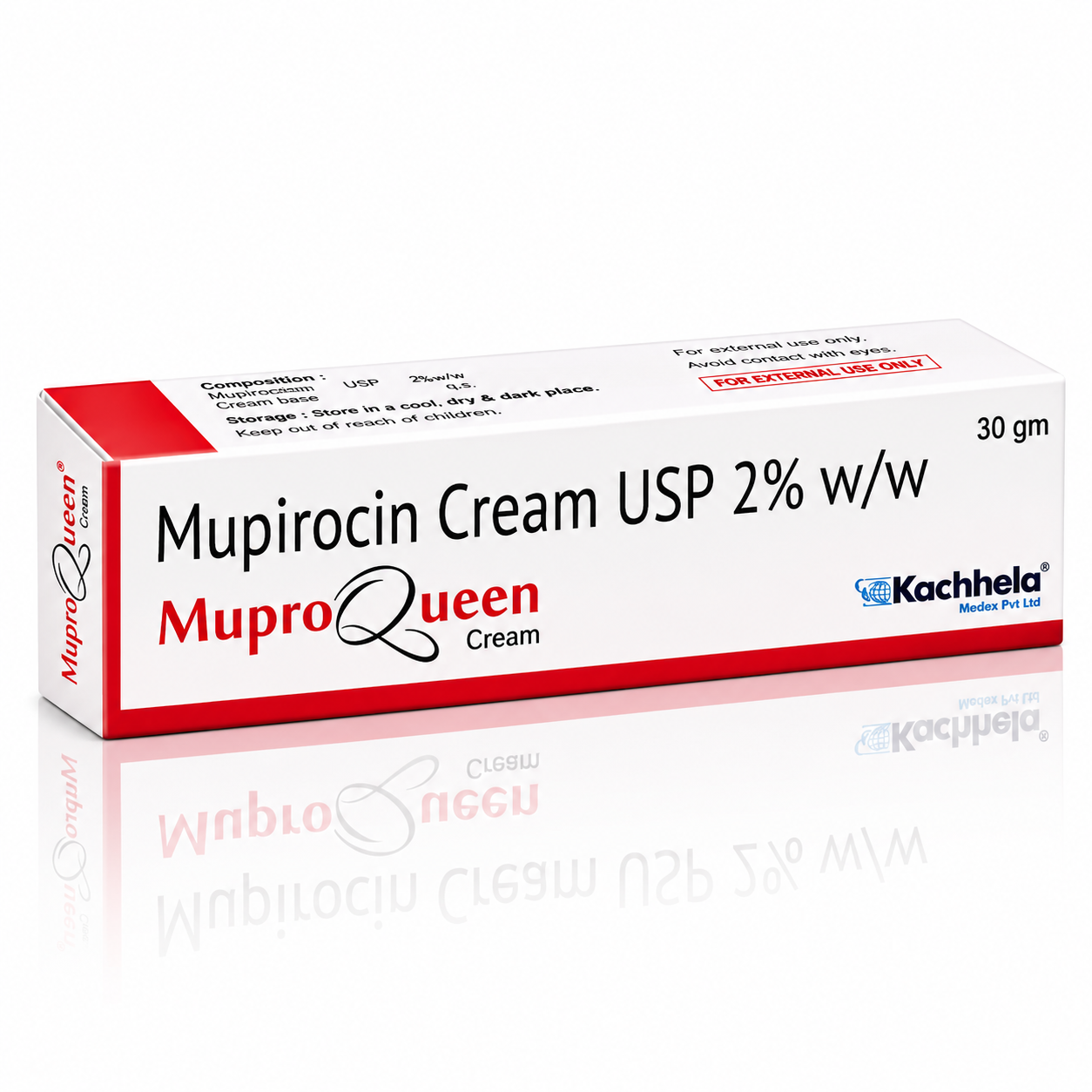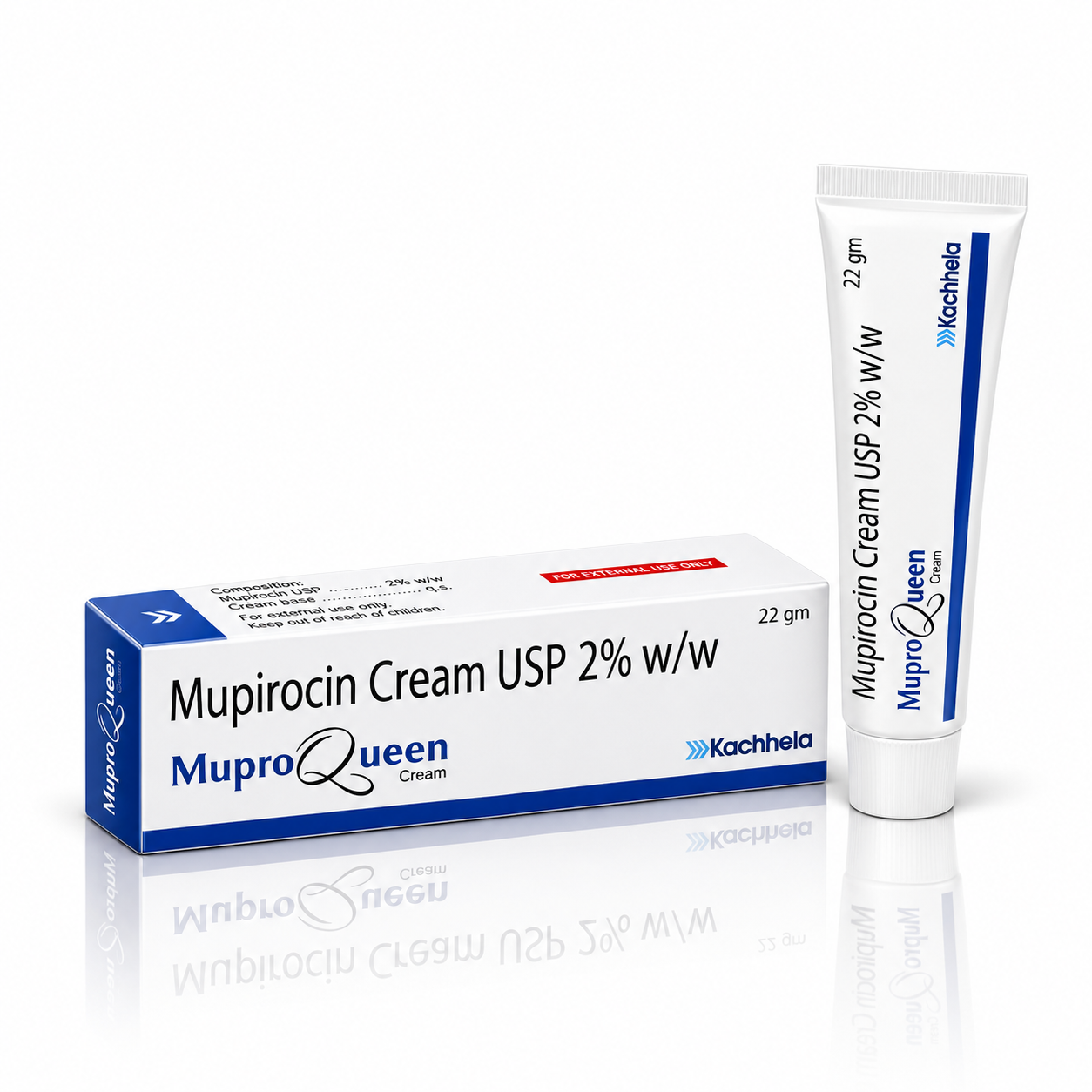
Muproqueen Cream 2% W/W (22 GM)
$10.00 / unit
Available Options
| Pack Size | Price | Price / Unit | Quantity | Action |
|---|---|---|---|---|
| 10 Cream | $75.00 | $7.50/unit | ||
| 8 Cream | $60.00 | $7.50/unit | ||
| 6 Cream | $45.00 | $7.50/unit | ||
| 4 Cream | $32.00 | $8.00/unit | ||
| 2 Cream | $18.00 | $9.00/unit | ||
| 1 Cream | $10.00 | $10.00/unit |
Product Description
MUPROQUEEN CREAM 2% W/W 22 GM
Brand Name: Muproqueen Cream
Generic Name: Mupirocin
Strength: 2% w/w (20 mg per gram)
Dosage Form: Topical Cream
Therapeutic Class: Topical Antibiotic / Antibacterial Medicine
Manufacturer / Marketer: Kachhela Medex Pvt. Ltd.
Pack Size: 1 × 22 GM Tube
Prescription Status: Prescription Medicine
Primary Indication: Localized Bacterial Skin Infections
What is this medicine?
MUPROQUEEN CREAM 2% W/W 22 GM contains Mupirocin, a topical antibacterial medicine used for selected localized bacterial infections of the skin.
Mupirocin belongs to a class of antibiotics that inhibit bacterial protein synthesis.
It is particularly effective against susceptible strains of:
Staphylococcus aureus
Streptococcus pyogenes
These bacteria can cause superficial skin infections and can infect skin that has been damaged by cuts, abrasions or other injuries.
Muproqueen may be prescribed for:
Secondarily infected minor cuts
Infected abrasions
Localized bacterial skin lesions
Certain superficial wound infections
Selected cases of impetigo
Other superficial infections caused by susceptible bacteria
The exact indication depends on the formulation and diagnosis.
Important: The established U.S. indication for mupirocin cream is secondarily infected traumatic skin lesions caused by susceptible S. aureus or S. pyogenes. Mupirocin ointment has a separate labeled indication for impetigo. Therefore, the approved indications of the cream and ointment should not automatically be treated as identical.
How Does Muproqueen Work?
Mupirocin acts by inhibiting bacterial protein synthesis.
It targets an enzyme called bacterial isoleucyl-transfer RNA synthetase (isoleucyl-tRNA synthetase).
This enzyme is essential for incorporating the amino acid isoleucine into bacterial proteins.
When mupirocin inhibits the enzyme, susceptible bacteria cannot produce essential proteins normally.
As a result:
Bacterial protein synthesis is disrupted.
Bacterial growth is inhibited.
Susceptible bacteria are controlled.
Localized bacterial infection may resolve.
Infection-related symptoms gradually improve.
Mupirocin is generally bacteriostatic at lower concentrations and may be bactericidal at the higher concentrations achieved during topical application.
1. Inhibition of Bacterial Protein Synthesis
Bacteria require proteins for growth and survival.
Mupirocin prevents susceptible bacteria from forming proteins through its action on isoleucyl-tRNA synthetase.
This mechanism differs from many other commonly used topical antibiotics.
2. Activity Against Staphylococcal Infections
Staphylococcus aureus is a common cause of bacterial skin infections.
It may cause:
Localized infected wounds
Pus-filled skin lesions
Impetigo
Certain follicular infections
Secondary infection of damaged skin
Mupirocin may be effective when the bacteria are susceptible.
Important: Methicillin-resistant Staphylococcus aureus (MRSA) is not uniformly susceptible to mupirocin. Treatment should account for local resistance patterns and, when indicated, culture results.
3. Activity Against Streptococcal Infections
Streptococcus pyogenes can also cause bacterial skin infections.
Mupirocin has activity against susceptible strains.
However, extensive or spreading streptococcal skin infections may require systemic antibiotic treatment.
Common Uses
Muproqueen Cream may be prescribed for:
Localized secondarily infected cuts
Infected abrasions
Selected superficial bacterial wounds
Minor traumatic skin lesions with secondary infection
Other appropriate localized bacterial skin infections
The doctor should determine whether a topical antibiotic is sufficient.
Secondarily Infected Cuts
Minor cuts can become infected when bacteria enter damaged skin.
Possible signs include:
Increasing redness
Tenderness
Local swelling
Pus formation
Yellowish discharge
Worsening discomfort
Muproqueen may help treat a localized infection caused by susceptible bacteria.
Important: Clean, uncomplicated cuts do not routinely require topical antibiotics.
Infected Abrasions
An abrasion occurs when the surface of the skin is scraped.
Bacterial infection can develop if the damaged area becomes contaminated.
Symptoms may include:
Redness
Tenderness
Oozing
Crusting
Local inflammation
Mupirocin cream may be appropriate when secondary bacterial infection is present.
Infected Traumatic Skin Lesions
Traumatic skin lesions include certain wounds resulting from injury.
Examples include:
Minor cuts
Scratches
Abrasions
Selected superficial injuries
The reference mupirocin cream label describes treatment of secondarily infected traumatic lesions measuring up to approximately 10 cm in length or 100 cm² in area.
Important: This size limit comes from the reference clinical labeling and does not establish that all wounds within those dimensions can be safely self-treated.
Impetigo
Impetigo is a contagious superficial bacterial skin infection.
Symptoms may include:
Small red sores
Blisters
Honey-colored crusts
Oozing
Mild itching
Mupirocin ointment is an established treatment for localized impetigo caused by susceptible bacteria.
Mupirocin cream may also be prescribed by clinicians in certain settings, but the approved indication depends on the formulation and jurisdiction.
Important: Extensive impetigo may require oral antibiotics or another treatment approach.
Bacterial Folliculitis
Folliculitis is inflammation of the hair follicles.
Bacterial folliculitis may cause:
Small red bumps
Pustules
Itching
Tenderness
Local irritation
Mupirocin may sometimes be selected for a localized infection caused by susceptible bacteria.
However, folliculitis may also have fungal, inflammatory or mechanical causes.
Important: Muproqueen should not be used routinely for every case of folliculitis.
Infected Eczema
Eczema causes skin inflammation and weakens the protective skin barrier.
This may allow bacteria to infect damaged areas.
Signs of bacterial infection may include:
Increased crusting
Oozing
Pustules
Tenderness
Rapidly worsening redness
Mupirocin may be considered when a clinician identifies a localized bacterial infection.
However, it does not directly treat the underlying inflammatory eczema.
Important: Not every eczema flare requires an antibiotic.
Important Treatment Limitations
Muproqueen should not routinely be used for:
Fungal skin infections
Ringworm
Athlete's foot
Jock itch
Viral skin infections
Cold sores
Chickenpox
Uninfected eczema
Routine acne treatment
Skin whitening
General moisturizing
Deep abscesses
Serious cellulitis
Extensive infected wounds
Routine prevention of infection in clean wounds
NOTE: Muproqueen does not contain a corticosteroid and is not intended for routine use as an anti-inflammatory cream.
What should I tell my healthcare provider before I take this medicine?
Inform your healthcare provider if you have:
Allergy to mupirocin
Previous reactions to antibiotic creams
Allergy to any ingredient in the formulation
Recurrent bacterial skin infections
Known antibiotic-resistant infections
Previous mupirocin treatment failure
Extensive skin infection
Deep wounds
Severe burns
Diabetes
Weakened immune function
Chronic eczema
Significant skin irritation
Fungal skin infections
Viral skin infections
Pregnancy or plans to become pregnant
Breastfeeding
Use of other topical antibiotics
Use of medicated creams
Use of topical corticosteroids
Tell your healthcare provider about all prescription medicines, nonprescription medicines and skin treatments you currently use.
Important Contraindications
Mupirocin cream is contraindicated in patients with:
Known hypersensitivity to mupirocin
Known serious allergy to any formulation ingredient
If a previous application caused a serious allergic reaction, the medicine should not be used again without medical assessment.
Important Antibiotic Resistance Warning
Unnecessary or prolonged mupirocin use may encourage resistant bacteria.
Risk may increase with:
Repeated treatment courses
Prolonged continuous application
Use without a bacterial infection
Unnecessary application to large areas
Continued use despite treatment failure
Important: Antibiotics should not be used indefinitely for recurring skin problems without identifying the underlying cause.
Important Eye Warning
Muproqueen Cream is intended for external skin application.
Avoid contact with the eyes.
Accidental eye exposure may cause:
Burning
Redness
Irritation
Watering
If cream enters the eyes, rinse thoroughly with clean water.
Important Intranasal Use Warning
Muproqueen Cream is not formulated for routine application inside the nose.
Mupirocin nasal preparations are specifically formulated for intranasal use.
Important: Do not use ordinary mupirocin skin cream inside the nostrils to treat nasal bacterial carriage unless a clinician has specifically provided appropriate product guidance.
Important Severe Infection Warning
Topical antibiotics are not adequate for every type of skin infection.
Seek medical evaluation for:
Rapidly spreading redness
Fever
Severe pain
Large abscesses
Extensive swelling
Red streaking
Significant tissue damage
Serious skin infections may require oral or intravenous antibiotics, drainage or other treatment.
Important Pregnancy Warning
Systemic exposure to mupirocin is generally low during limited topical use.
However, adequate human pregnancy data are limited.
Important: Use during pregnancy only when a healthcare professional determines that treatment is appropriate.
How should I use this medicine?
Use Muproqueen Cream 2% w/w 22 GM exactly as prescribed by your healthcare provider.
Apply only to the affected skin.
Wash your hands before and after application.
Gently clean and dry the affected area.
Apply a small amount in a thin layer.
Avoid applying excessive quantities.
Keep the cream away from the eyes, nose and mouth.
Do not apply to mucous membranes.
Use only for the prescribed duration.
Avoid combining with other creams on the same area unless instructed.
Do not share the medicine.
Understanding the Cream Strength
Each gram of Muproqueen Cream contains:
Mupirocin: 20 mg
Strength: 2% w/w
Dosage Form: Topical cream
Route of Administration: External skin application
Tube Size: 22 GM
Total Active Ingredient in the Tube: Approximately 440 mg of mupirocin.
The total amount in the tube does not represent an individual dose.
Usual Adult Dosage
A standard reference regimen for mupirocin 2% cream is:
Apply a small amount to the affected area three times daily for 10 days.
Treatment should be reassessed if there is no clinical improvement within 3–5 days.
This regimen comes from U.S. mupirocin cream prescribing information. The patient should follow the exact duration and application frequency prescribed for Muproqueen.
How to Apply Muproqueen Cream
Wash your hands thoroughly.
Gently clean the affected area.
Pat the skin dry using a clean towel or gauze.
Apply a small amount of cream to a clean fingertip or cotton swab.
Spread a thin layer over the prescribed area.
Avoid excessive rubbing.
Cover with a suitable gauze dressing if instructed.
Wash your hands afterward unless they are being treated.
Close the tube securely.
Continue for the prescribed treatment period.
Application for Infected Cuts
When prescribed for a localized infected cut:
Gently clean the affected area.
Apply a small amount of Muproqueen.
Use a dressing if recommended.
Monitor for reduced redness and tenderness.
Seek medical advice if the infection spreads.
Important: Deep, heavily contaminated or large wounds require professional assessment.
Application for Infected Abrasions
For a secondarily infected abrasion:
Clean the area appropriately.
Apply a thin layer of cream.
Avoid scratching or picking.
Follow the prescribed schedule.
Observe for improvement.
Application for Impetigo
When a clinician specifically prescribes mupirocin cream for impetigo:
Apply only to the infected lesions.
Avoid scratching.
Wash hands regularly.
Do not share towels or clothing.
Follow medical advice about covering lesions and limiting transmission.
Important: Mupirocin ointment has a distinct approved indication for impetigo in some countries. Follow the prescribed formulation rather than substituting products independently.
Important Treatment Duration
Mupirocin cream is generally used for a short course.
A standard reference course is 10 days.
Prolonged or repeated use may increase the likelihood of antibiotic resistance.
Important: Do not continue Muproqueen for weeks simply because some redness remains. Persistent symptoms require reassessment.
Children and Adolescents
The U.S. mupirocin cream label establishes use in pediatric patients aged 3 months to 16 years for its approved indication.
The safety and effectiveness in infants younger than 3 months have not been established in that reference.
Use in children should follow the pediatrician's instructions and applicable Indian product labeling.
Older Adults
Older adults may have fragile skin, slow-healing wounds or underlying conditions affecting infection recovery.
The clinician should consider:
Skin condition
Infection severity
Diabetes
Circulation problems
Other prescribed medicines
Special Patient Populations
Diabetes: Infections may heal more slowly and sometimes require additional treatment.
Immunocompromised Patients: May require closer monitoring or systemic antibiotic treatment.
Kidney Disease: Limited topical cream use usually results in low systemic exposure; assess extensive or damaged areas individually.
Liver Disease: Routine limited topical application generally results in minimal systemic exposure.
Pregnancy: Use when clinically necessary after professional assessment.
Breastfeeding: Avoid infant contact with treated skin and do not apply to the breasts without specific medical instructions.
How Long Does Muproqueen Take to Work?
Mupirocin begins inhibiting susceptible bacteria after application.
Visible clinical improvement may occur over several days.
Symptoms that may improve include:
Redness
Tenderness
Crusting
Local swelling
Pus or discharge
The response depends on:
Type of infection
Bacterial susceptibility
Severity
Correct application
Other underlying conditions
Important: If no improvement occurs within 3–5 days, consult the prescriber rather than simply extending treatment.
What if I miss a dose?
If you miss an application:
Apply the cream when remembered unless the next application is approaching.
If the next application is nearly due, skip the missed application.
Continue with the usual schedule.
Do not apply a thick layer to compensate.
Do not double the next application.
Important: Applying extra cream does not make the infection resolve faster and may increase irritation.
What may interact with this medicine?
Mupirocin cream is applied topically and generally produces minimal systemic exposure during appropriate limited-area use.
Clinically significant interactions with medicines taken orally are not commonly expected.
However, combining it with other topical products may affect application or increase irritation.
Potential Interaction Considerations
Other topical antibiotics
Topical corticosteroids
Antiseptic creams
Benzoyl peroxide
Topical retinoids
Exfoliating acids
Other medicated creams
Skin products applied to the same area
Important Drug Interaction Considerations
Other Topical Antibiotics: Combining topical antibiotics may be unnecessary unless prescribed.
Topical Corticosteroids: May be prescribed for separate inflammatory conditions, but should not be added to an infected lesion without professional guidance.
Benzoyl Peroxide: May increase irritation, particularly on damaged skin.
Tretinoin or Adapalene: May cause additional dryness or irritation.
Salicylic Acid: Can irritate broken or infected skin.
Other Medicated Creams: Simultaneous application may affect absorption, spreading or tolerability.
These are primarily treatment-combination precautions rather than established systemic drug interactions.
Important Mixing With Other Topical Products
Reference mupirocin cream labeling advises against applying other lotions, creams or ointments concurrently to the same area.
Mixing products may dilute or spread the antibiotic and can make the treatment less predictable.
Important: Follow the prescribed skin-care regimen rather than layering multiple products over Muproqueen.
Important Antibiotic Resistance Consideration
Using antibiotics without an appropriate indication can increase antimicrobial resistance.
Do not combine Muproqueen with other antibiotic creams simply to obtain a stronger effect.
Important Drug Interaction Precaution
Tell your healthcare provider about all medicines and skin preparations you currently use, including prescription creams, antiseptics and over-the-counter skincare products.
What should I watch for while using this medicine?
Contact your healthcare provider if you experience:
Worsening redness
Increasing swelling
Persistent burning
Significant itching
Severe skin irritation
New pustules
Spreading infection
Increasing tenderness
Persistent discharge
New skin rash
No improvement after 3–5 days
Seek urgent medical attention for:
Severe allergic reactions
Difficulty breathing
Swelling of the face or throat
Rapidly spreading redness with fever
Severe skin pain
Extensive blistering
Serious infection-related symptoms
Important Monitoring
Bacterial Infection: Monitor whether redness, swelling and discharge improve.
Wound Healing: Observe whether the affected area gradually recovers.
Skin Irritation: Watch for burning, itching or contact dermatitis.
Antibiotic Response: Reassess persistent infections.
Treatment Duration: Avoid unnecessary extended use.
Recurrence: Repeated infections may require culture testing or investigation of underlying causes.
Important Antibiotic Resistance Monitoring
Some bacteria may develop resistance to mupirocin.
Signs suggesting treatment failure include:
Persistent infection
Recurrent lesions
Continued pus formation
Increasing redness
Poor response despite correct use
A healthcare professional may recommend:
Bacterial culture
Susceptibility testing
A different antibiotic
Evaluation for another diagnosis
Important Fungal Overgrowth Warning
Prolonged antibiotic use may occasionally allow nonsusceptible microorganisms, including fungi, to proliferate.
The reference product labeling advises discontinuation and reassessment if microbial overgrowth occurs.
Important Wound Infection Monitoring
Seek medical attention for:
Worsening pain
Increasing discharge
Fever
Spreading redness
Rapid swelling
Red streaking
These may indicate an infection requiring treatment beyond a topical antibiotic.
Important Severe Diarrhea Warning
Although systemic absorption of topical mupirocin is generally low, antibiotic-associated diarrhea, including Clostridioides difficile-associated diarrhea, is included in prescribing warnings.
Persistent or severe watery or bloody diarrhea requires medical evaluation.
Important: Do not assume severe diarrhea is harmless simply because an antibiotic is applied to the skin.
What side effects may I notice from this medicine?
Muproqueen Cream 2% w/w may cause mild, moderate or serious adverse effects.
Side effects that should be reported promptly:
Severe allergic reactions
Significant contact dermatitis
Severe burning or skin irritation
Worsening bacterial infection
Extensive rash
Hives
Facial swelling
Severe diarrhea
Signs of microbial overgrowth
Side effects that may not require immediate medical attention:
Mild burning
Stinging
Itching
Redness
Application-site irritation
Mild skin rash
Headache
Nausea
Clinical trials of mupirocin cream reported headache, rash and nausea among adverse events occurring in at least 1% of patients. Local reactions may also occur. These are data from reference mupirocin cream studies, not Muproqueen-specific clinical trials.
Important Application-Site Reactions
Some patients may experience:
Burning
Stinging
Itching
Redness
Local discomfort
Mild symptoms may be temporary.
However, severe or persistent irritation requires medical assessment.
Important Contact Dermatitis
Contact dermatitis may develop in response to mupirocin or an inactive cream ingredient.
Possible symptoms include:
Redness
Itching
Swelling
Irritation
Eczematous rash
The exact inactive ingredient list for Muproqueen should be checked on the supplied packaging.
Important Allergic Reactions
Rare serious allergic reactions have been reported with topical mupirocin products.
Symptoms may include:
Hives
Generalized rash
Angioedema
Difficulty breathing
Swelling of the face or throat
Important: Severe allergic reactions require emergency medical attention.
Important Eye Irritation
Accidental eye exposure may cause:
Burning
Redness
Watering
Discomfort
Rinse thoroughly with water after accidental exposure.
Persistent symptoms require medical attention.
Important Persistent Infection
If symptoms worsen despite treatment, possible causes include:
Bacterial resistance
Incorrect diagnosis
Inadequate treatment
Deeper infection
Another underlying skin condition
The prescriber may need to change the treatment plan.
Important Pregnancy and Breastfeeding Considerations
Pregnancy: Available human data are insufficient to establish all risks. Limited topical application generally results in low systemic exposure, but treatment should still be discussed with a healthcare professional.
Breastfeeding: It is not known whether clinically relevant amounts enter breast milk after topical use. Avoid application to areas where an infant may ingest the cream. If treatment of the breast is medically necessary, follow specific instructions on cleaning the area before feeding.
Important: Pregnant or breastfeeding patients should use Muproqueen only when the clinician considers treatment appropriate.
Where should I keep my medicine?
Store below 25°C according to available Muproqueen distributor listings.
Keep in a cool, dry place.
Protect from direct sunlight.
Protect from excessive heat.
Do not freeze unless the original label specifically permits it.
Keep the tube tightly closed.
Store in the original packaging.
Keep out of the reach of children.
Keep away from pets.
Do not use after the expiry date.
Do not use a damaged or leaking tube.
Avoid contaminating the tube opening.
Do not share the cream.
Dispose of expired or unused medicine according to pharmacist instructions.
Storage Note: Indian distributor listings specify storage below 25°C and a listed 36-month shelf life. Follow the instructions on the supplied Muproqueen tube or carton if they differ.
Manufacturer Details
Field | Information |
|---|---|
Brand Name | Muproqueen Cream |
Generic Name | Mupirocin |
Strength | 2% w/w |
Active Ingredient per Gram | 20 mg |
Total Active Ingredient in 22 GM | Approximately 440 mg |
Dosage Form | Topical Cream |
Therapeutic Class | Topical Antibiotic / Antibacterial Medicine |
Primary Indication | Secondarily Infected Traumatic Skin Lesions |
Common Uses | Selected Infected Cuts, Abrasions and Localized Bacterial Skin Lesions |
Additional Clinician-Directed Uses | Certain Superficial Bacterial Skin Infections |
Mechanism of Action | Inhibits Bacterial Isoleucyl-tRNA Synthetase and Protein Synthesis |
Main Susceptible Organisms | Staphylococcus aureus and Streptococcus pyogenes |
Manufacturer / Marketer | Kachhela Medex Pvt. Ltd., According to Supplier Listing |
Actual Manufacturing Facility | Verify from Current Product Packaging |
Manufacturer Address | Verify from Current Product Packaging |
Prescription Status | Prescription Medicine |
Route of Administration | Topical / External Skin Application |
Usual Reference Application Frequency | Three Times Daily |
Reference Treatment Duration | 10 Days |
Treatment Reassessment | If No Improvement Within 3–5 Days |
Steroid Content | None Listed |
Antifungal Activity | Not an Antifungal Treatment |
Storage | Below 25°C, According to Distributor Listings |
Retail Pack Size | 1 × 22 GM Tube |
Packaging Type | Topical Cream Tube |
Supplier-Listed Shelf Life | 36 Months |
Country of Origin | India, According to Supplier Listing |