Erectile dysfunction (ED) and benign prostatic hyperplasia (BPH), commonly called an enlarged prostate, frequently affect men as they get older. ED makes it difficult to achieve or maintain an erection firm enough for sexual activity, while BPH can cause urinary problems such as frequent urination, a weak urine stream, urgency, and waking repeatedly during the night to urinate.
Although ED and BPH are separate conditions, they can occur together. This creates an important treatment question:
Can one medicine help improve both erectile function and urinary symptoms?
For some men, the answer may be tadalafil.
Tadalafil is a phosphodiesterase type 5 (PDE5) inhibitor commonly used for erectile dysfunction. A 5 mg once-daily tadalafil regimen is also indicated for the signs and symptoms of BPH and for men who have both ED and BPH.
However, tadalafil is not appropriate for everyone. Understanding how it works, what symptoms it may improve, and its potential interactions is essential before treatment.
What Is an Enlarged Prostate?
The prostate is a gland located below the bladder and surrounding part of the urethra.
An enlarged prostate can put pressure around the urinary pathway and contribute to lower urinary tract symptoms.
Common BPH symptoms include:
Frequent urination
Urgent need to urinate
Waking during the night to urinate
Difficulty starting urination
Weak or interrupted urine stream
Dribbling after urination
Feeling that the bladder has not completely emptied
Importantly, BPH is not prostate cancer, although some urinary symptoms can overlap with those caused by other prostate or urinary conditions. Men developing new or worsening urinary symptoms should therefore receive an appropriate medical evaluation.
What Is Erectile Dysfunction?
ED can involve:
Difficulty achieving an erection
Erections that are not firm enough
Difficulty maintaining an erection
Erections occurring inconsistently
ED may have several causes, including vascular disease, diabetes, high blood pressure, hormonal abnormalities, certain medicines, nerve problems, psychological factors and lifestyle-related conditions. Enlarged prostate and other male reproductive conditions may also be associated with ED.
ED is not simply an inevitable part of getting older. Persistent erection difficulties should be discussed with a healthcare professional because ED can sometimes be associated with another underlying medical condition.
Why Can Erectile Dysfunction and BPH Occur Together?
ED and lower urinary tract symptoms associated with BPH become more common with increasing age.
The relationship between the two conditions is complex. They may share several biological and health-related factors, including changes affecting:
Blood vessel function
Smooth-muscle activity
Nitric oxide signaling
Pelvic circulation
Metabolic health
Research has found that treating men who have both conditions with tadalafil can improve measures of erectile function as well as BPH-related urinary symptoms.
This is one reason tadalafil is particularly interesting for men experiencing both conditions.
Can Tadalafil Help Both Erectile Dysfunction and BPH?
This differs from tadalafil used only as an occasional ED treatment, where other dosing approaches may be prescribed.
The exact treatment plan should always be determined by a healthcare professional based on the patient's medical history, kidney and liver function, other medicines and treatment goals.
How Does Tadalafil Help Erectile Dysfunction?
Tadalafil belongs to a group of medicines known as PDE5 inhibitors.
During sexual stimulation, the body releases nitric oxide. This activates biological processes that relax smooth muscle and allow more blood to enter erectile tissue.
PDE5 normally helps break down one of the signaling molecules involved in this process.
By inhibiting PDE5, tadalafil helps maintain the pathway responsible for smooth-muscle relaxation and increased blood flow.
The result can be:
Improved penile blood flow → stronger erectile response during sexual stimulation.
Tadalafil does not automatically cause an erection. Sexual stimulation is still required for the erectile response to occur.
How Does Tadalafil Help Enlarged-Prostate Symptoms?
Tadalafil also influences smooth-muscle and signaling pathways within the lower urinary tract.
Its effects can help reduce BPH-associated urinary symptoms.
Potential improvements may include:
Less urinary urgency
Less frequent urination
Improved urinary comfort
Less difficulty starting urination
Reduced nighttime urination
Improvement in overall lower urinary tract symptoms
NIDDK lists tadalafil among medicines that may be used to treat symptoms associated with BPH.
Tadalafil should therefore be thought of primarily as a symptom treatment for BPH rather than a procedure that removes enlarged prostate tissue.
Why Tadalafil May Be Useful When ED and BPH Occur Together
For an appropriate patient with both conditions, once-daily tadalafil may provide several practical advantages.
1. It Targets Two Conditions With One Medicine
Rather than addressing erectile function and urinary symptoms completely separately, tadalafil may improve symptoms of both disorders.
Studies involving men with both ED and BPH-associated lower urinary tract symptoms have demonstrated improvements in measures of both erectile function and urinary symptoms compared with placebo.
2. Daily Treatment Does Not Need to Be Timed Around Sexual Activity
This may be convenient for men who prefer not to plan ED medication around a specific sexual encounter.
3. It Can Improve Erectile Function
Tadalafil can enhance the normal erectile response by improving the blood-flow pathway involved in erections.
PDE5 inhibitors are widely used oral treatments for ED.
4. It Can Reduce Lower Urinary Tract Symptoms
Clinical trials have found significant improvement in standardized BPH symptom scores among men receiving tadalafil compared with placebo.
5. It May Simplify Treatment for Some Men
When a man has both ED and BPH symptoms, a treatment capable of addressing both may reduce the need for separate medicines.
However, treatment choice depends on the severity and cause of the urinary symptoms. Some patients may still need other BPH treatments or procedures.
Does Tadalafil Shrink an Enlarged Prostate?
Tadalafil primarily works by improving functional pathways involved in the urinary tract and relieving symptoms.
It should not be confused with medications such as 5-alpha-reductase inhibitors, which may be prescribed in appropriate patients to influence prostate growth over time.
Therefore, improvement in urination while taking tadalafil does not necessarily mean the enlarged prostate itself has been eliminated.
Men with substantial prostate enlargement, progressive symptoms or complications may require additional treatment.
How Quickly Does Tadalafil Improve BPH Symptoms?
Responses vary from person to person.
BPH treatment studies generally assess symptom improvement over several weeks rather than expecting immediate resolution after a single tablet.
A pooled analysis of randomized studies found that once-daily tadalafil improved standardized lower urinary tract symptom scores as well as erectile-function scores in men who had both conditions.
Patients should follow the treatment schedule prescribed by their clinician rather than adjusting the dose themselves when symptoms do not improve immediately.
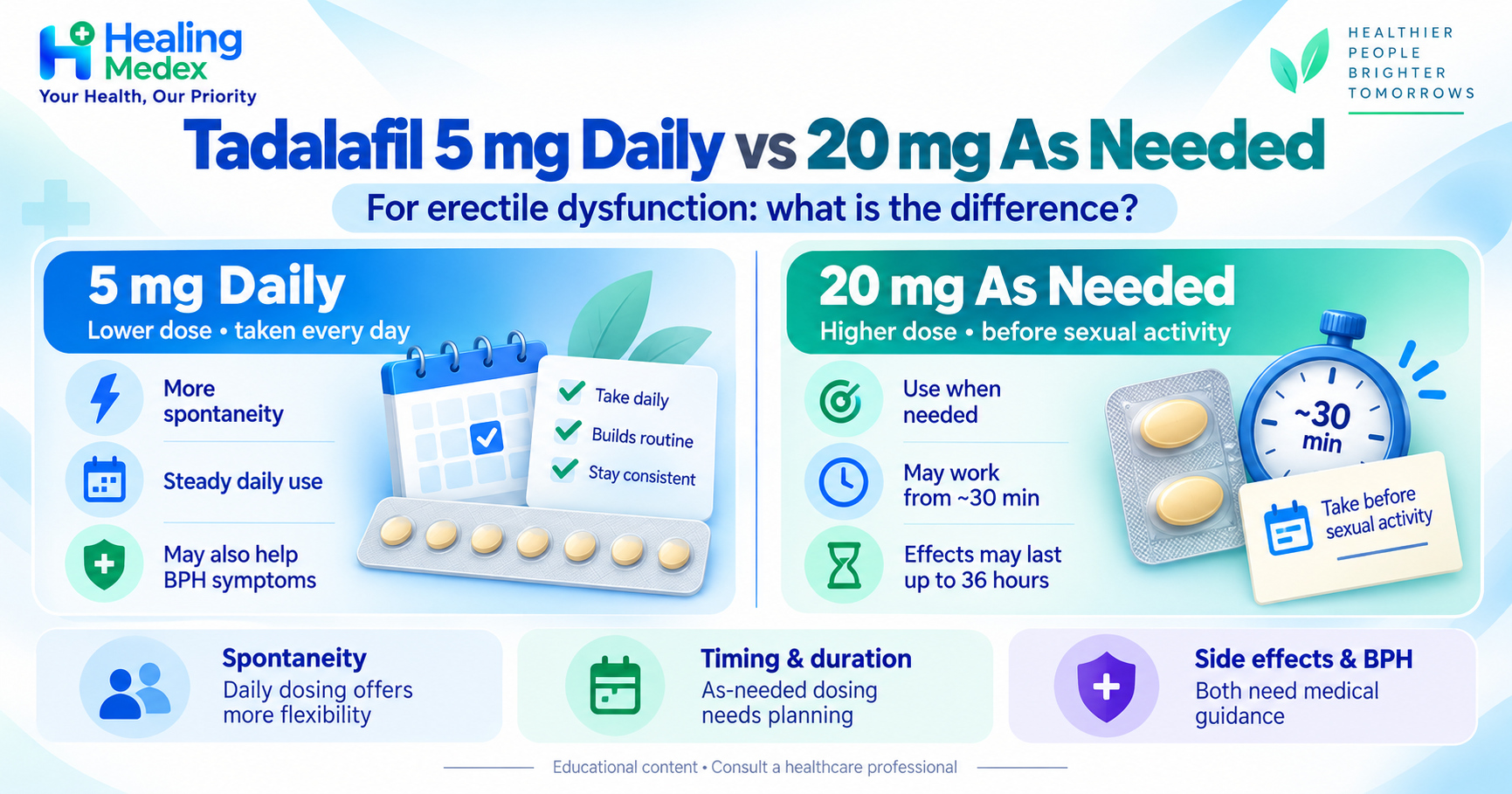
Is Tadalafil 5 mg Daily Different From Tadalafil 10 mg or 20 mg?
Yes.
Tadalafil may be prescribed differently depending on why it is being used.
For ED as needed
Tadalafil may be prescribed before anticipated sexual activity. Prescribing information lists 10 mg as a typical starting as-needed dose, which may be adjusted to 5 mg or 20 mg depending on effectiveness and tolerability.
For daily ED treatment
Tadalafil may be prescribed at 2.5 mg once daily, with adjustment to 5 mg when appropriate.
For BPH
The recommended dose is 5 mg once daily.
For ED and BPH together
The recommended dose is 5 mg once daily, taken at approximately the same time each day.
Patients should not switch between dosing schedules without medical guidance.
What Are the Common Side Effects of Tadalafil?
Most people who tolerate tadalafil experience either no significant problems or relatively mild adverse effects.
Possible side effects include:
Headache
Indigestion
Flushing
Nasal congestion
Back pain
Muscle aches
Individual responses vary.
The risks can also depend on other medicines, cardiovascular health, alcohol intake and underlying medical conditions.
Who Should Not Take Tadalafil?
Tadalafil is not suitable for everyone.
Nitrate Medicines
Tadalafil must not be combined with nitrate medicines.
Nitrates may include medicines such as:
Nitroglycerin
Isosorbide mononitrate
Isosorbide dinitrate
Combining nitrates with tadalafil can cause a dangerous fall in blood pressure. Current prescribing information lists nitrate use as a contraindication to tadalafil therapy.
Riociguat
Tadalafil is also contraindicated with guanylate cyclase stimulators such as riociguat, because combining them can excessively lower blood pressure.
Alpha-Blockers Require Special Attention
Alpha-blockers such as tamsulosin and similar medicines are commonly used for BPH.
Because both alpha-blockers and tadalafil can lower blood pressure, combining them can increase the risk of:
Dizziness
Light-headedness
Fainting
Low blood pressure
Current tadalafil prescribing information specifically states that combining tadalafil with alpha-blockers is not recommended for the treatment of BPH because of blood-pressure concerns and limitations in the evidence supporting the combination.
Anyone already taking an alpha-blocker should tell their healthcare provider before starting tadalafil.
Cardiovascular Conditions
Sexual activity places additional demand on the cardiovascular system.
A healthcare professional should assess whether sexual activity and ED treatment are appropriate for men with significant heart disease or certain cardiovascular conditions.
When Should You Seek Immediate Medical Care?
Although serious tadalafil reactions are uncommon, some symptoms require urgent medical attention.
Seek immediate medical care for:
An erection lasting longer than four hours
A prolonged erection, known as priapism, may permanently damage erectile tissue if it is not treated promptly.
Sudden loss or significant reduction of vision
Stop taking tadalafil and seek medical care immediately.
Sudden hearing loss or major reduction in hearing
Prompt medical assessment is required, particularly if accompanied by dizziness or ringing in the ears.
These warnings are included in current tadalafil prescribing information.
When Should Men With BPH Symptoms See a Doctor?
Do not assume every urinary problem is caused by an enlarged prostate.
Similar symptoms can sometimes occur with:
Urinary tract infections
Prostatitis
Bladder disorders
Urethral narrowing
Neurological disorders
Prostate cancer
Other urinary conditions
Current tadalafil prescribing information recommends evaluating other possible urological causes before beginning treatment for presumed BPH.
A medical assessment is particularly important if urinary problems are new, worsening or accompanied by other symptoms.
Seek prompt medical attention if you:
Cannot urinate
Have blood in the urine
Have severe urinary pain
Develop fever or chills with urinary symptoms
Experience rapidly worsening urinary problems
Can Lifestyle Changes Help ED and BPH?
Medication is only one part of treatment.
Certain lifestyle changes may improve overall sexual and urinary health.
Helpful measures may include:
Maintaining a healthy body weight
Exercising regularly
Stopping smoking
Limiting excessive alcohol
Managing diabetes
Controlling blood pressure and cholesterol
Following a balanced diet
Discussing medicines that may contribute to ED with a healthcare professional
NIDDK recommends measures including physical activity, maintaining a healthy weight, limiting alcohol and stopping smoking as part of managing factors that can contribute to erectile dysfunction.
For urinary symptoms, some men also find it useful to reduce large amounts of fluid immediately before bedtime and moderate beverages that increase urinary urgency.
Tadalafil for ED and BPH: Frequently Asked Questions
1.Can tadalafil treat erectile dysfunction and an enlarged prostate at the same time?
2.Does tadalafil cure BPH?
No. Tadalafil can improve lower urinary tract symptoms associated with BPH, but treatment should not be considered a permanent cure for prostate enlargement.
3.Does tadalafil permanently cure erectile dysfunction?
No. Tadalafil helps improve erectile function while the medicine is active in the body, but it does not necessarily eliminate the underlying cause of ED.
Conditions such as diabetes, cardiovascular disease, obesity, hormonal disorders or medication effects may also need to be addressed.
4.Do you need sexual stimulation when taking tadalafil?
Yes.
Tadalafil supports the physiological processes involved in an erection but does not automatically create one. Sexual stimulation is still required.
5. Can I take tadalafil with tamsulosin?
The combination requires medical supervision because both medicines can reduce blood pressure. Current tadalafil prescribing information does not recommend combining tadalafil with alpha-blockers specifically for BPH treatment.
Do not add tadalafil to an existing BPH medicine without speaking with a healthcare professional.
6.Can tadalafil be taken every day?
Yes, tadalafil has approved once-daily dosing regimens for certain indications.
The Bottom Line
Men with an enlarged prostate frequently experience troublesome urinary symptoms, and some also have erectile dysfunction.
Tadalafil is unusual because it can address both problems with a single medicine in appropriately selected patients.
A 5 mg once-daily tadalafil regimen is indicated for men with both erectile dysfunction and BPH symptoms. It can improve erectile response during sexual stimulation while also reducing lower urinary tract symptoms associated with an enlarged prostate.
However, tadalafil is not suitable for every patient. It should never be taken with nitrate medicines or riociguat, and particular caution is required with alpha-blockers, blood-pressure medicines and certain cardiovascular conditions.
Men experiencing ED together with urinary symptoms should therefore have both problems properly evaluated rather than treating either condition on their own.
A healthcare professional can determine whether tadalafil, another BPH treatment, an ED treatment, lifestyle changes or a combination of approaches is most appropriate.