Introduction
Benzoyl peroxide is one of the most widely used ingredients for treating acne, pimples, and inflammatory breakouts. It is available in different strengths, including 2.5%, 5%, and 10%, making it a popular treatment option for people with mild to moderate acne.
However, choosing the right concentration can be confusing. Many people assume that a higher percentage of benzoyl peroxide will eliminate pimples faster and provide better results.
But does stronger always mean better?
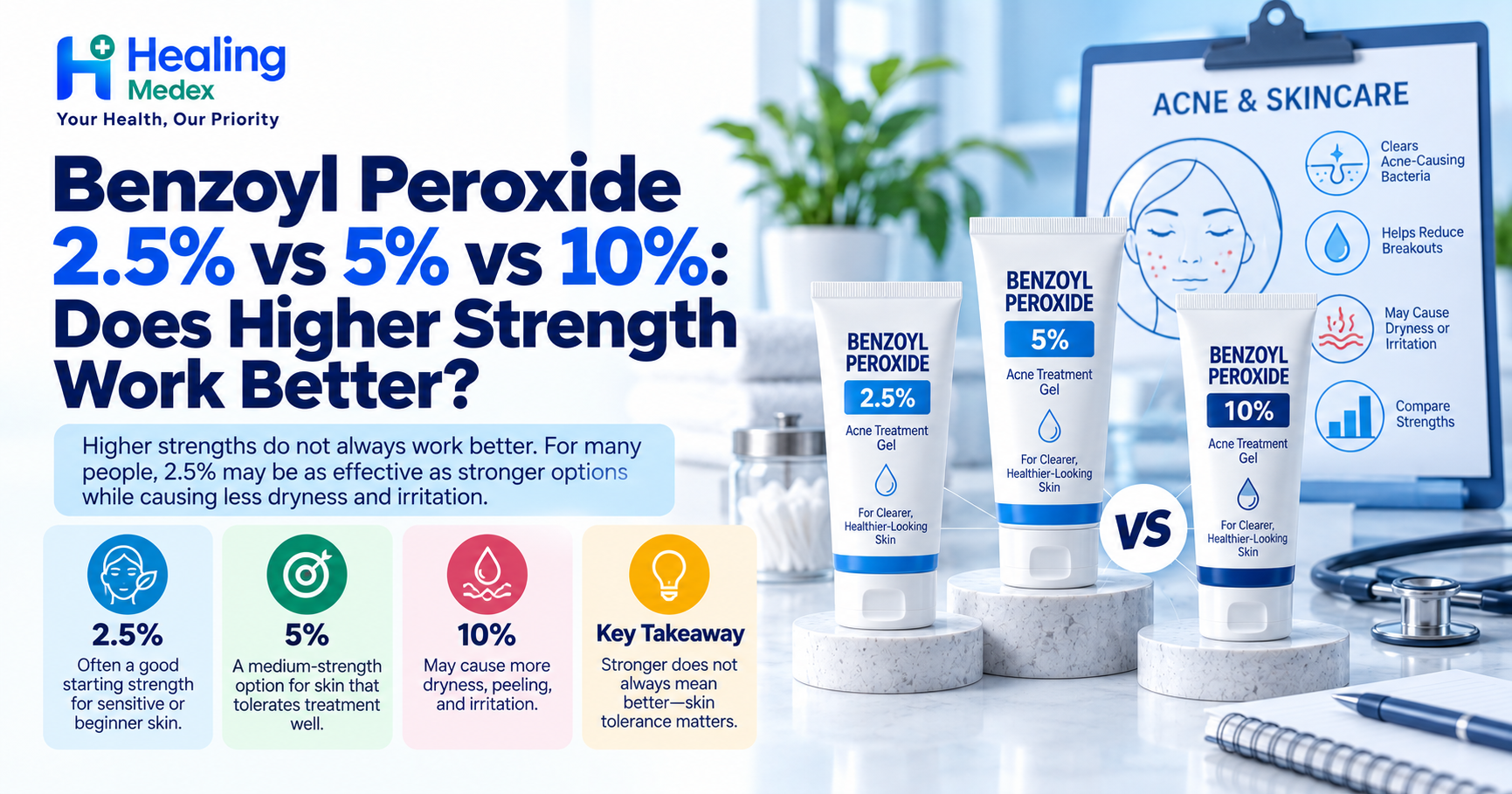
Research suggests that benzoyl peroxide 2.5% can be just as effective as 5% or 10% for many people with inflammatory acne, while higher strengths may increase the risk of dryness, redness, peeling, and irritation.
PubMed+1
In this Healing Medex guide, we explain the differences between benzoyl peroxide 2.5%, 5%, and 10%, their effectiveness, possible side effects, and how to choose the right strength for your skin.
What Is Benzoyl Peroxide?
Benzoyl peroxide is a topical acne treatment commonly available in creams, gels, lotions, and facial washes.
It helps treat acne by reducing acne-causing bacteria and improving inflammatory breakouts.
How Does Benzoyl Peroxide Work?
Benzoyl peroxide works in several ways:
Reduces acne-causing bacteria: Helps control Cutibacterium acnes, a bacterium associated with inflammatory acne.
Helps clear blocked pores: Reduces the buildup of dead skin cells that can contribute to pimples.
Improves inflammatory acne: Helps reduce red, swollen pimples and pus-filled spots.
Supports acne management: Can be combined with other treatments, such as adapalene, when appropriate.
Unlike topical antibiotics, benzoyl peroxide does not promote bacterial resistance in the same way, making it a valuable ingredient in long-term acne management.
Benzoyl Peroxide 2.5% vs 5% vs 10%: Key Differences
The main difference between these concentrations is the amount of active benzoyl peroxide present in the product.
Feature | 2.5% | 5% | 10% |
|---|---|---|---|
Strength | Low | Medium | High |
Acne effectiveness | Effective | Effective | Effective |
Best suited for | Beginners, sensitive skin | Skin tolerating lower strengths | Selected cases under professional guidance |
Irritation potential | Generally lower | Moderate | Generally higher |
Dryness and peeling | Possible | Possible | More likely |
Better than 2.5%? | — | Not consistently | Not consistently |
The actual results also depend on the formulation, frequency of application, skin sensitivity, and other acne treatments being used.
1. Benzoyl Peroxide 2.5%: Is Lower Strength Enough?
Benzoyl peroxide 2.5% is often a suitable starting option for people who are new to acne treatment.
Despite being the lowest of the three concentrations, it can effectively reduce inflammatory acne.
Benefits of Benzoyl Peroxide 2.5%
Helps treat mild to moderate inflammatory pimples.
Usually has a lower risk of irritation than 10%.
May be more suitable for sensitive or easily irritated skin.
Can be incorporated into a consistent skincare routine.
Who Should Consider 2.5%?
Benzoyl peroxide 2.5% may be appropriate for people who have mild inflammatory acne, are using benzoyl peroxide for the first time, or have experienced dryness from stronger acne products.
The American Academy of Dermatology recommends starting with 2.5% to help minimize skin irritation.
American Academy of Dermatology
2. Benzoyl Peroxide 5%: Does Medium Strength Work Better?
Benzoyl peroxide 5% is another common concentration used to manage acne.
It provides a higher concentration of active ingredient than 2.5%, but this does not automatically mean it will produce better results.
Benefits of Benzoyl Peroxide 5%
Helps reduce inflammatory pimples.
Is available in both leave-on and wash-off formulations.
May be suitable for people whose skin tolerates benzoyl peroxide.
Can form part of an acne treatment plan recommended by a dermatologist.
Is 5% More Effective Than 2.5%?
Not necessarily.
A randomized clinical study involving 609 participants compared benzoyl peroxide 2.5% and 5% gels.
The median reduction in inflammatory acne lesions was:
2.5% benzoyl peroxide
72.7%
Median lesion reduction
5% benzoyl peroxide
75.0%
Median lesion reduction
Results from one 12-week clinical trial, not guaranteed individual outcomes.
Wiley Online Library
Both strengths were effective, and the small numerical difference does not establish that 5% is clinically superior.
3. Benzoyl Peroxide 10%: Is Stronger Better for Stubborn Acne?
Benzoyl peroxide 10% contains four times as much active ingredient as 2.5%.
This may sound more powerful, but a higher concentration does not guarantee faster or better acne improvement.
Potential Benefits of Benzoyl Peroxide 10%
Provides a higher concentration of the active ingredient.
May be considered in selected treatment plans when lower strengths are not suitable.
Is available in certain washes and leave-on products.
Possible Disadvantages
Benzoyl peroxide 10% can be more irritating, particularly when applied to sensitive areas of the face.
Possible problems include:
Excessive dryness and flaking.
Redness or visible irritation.
Burning or stinging sensations.
Disruption of the skin's moisture barrier.
A comparative clinical trial found that 2.5% benzoyl peroxide was equivalent to 5% and 10% for reducing inflammatory acne lesions, while irritation was more frequent with the 10% preparation.
PubMed
Important: Benzoyl peroxide 10% should not automatically be chosen for severe acne. Deep, painful, cystic, or scarring acne often requires additional treatment from a dermatologist.
4. Does Higher Benzoyl Peroxide Strength Work Faster?
One of the biggest misconceptions about benzoyl peroxide is that a 10% product will clear acne much faster than 2.5%.
However, available evidence does not consistently demonstrate that higher concentrations produce faster or better improvement.
Skin tolerance is also important.
If a stronger concentration causes excessive irritation, a person may need to reduce treatment frequency or stop using the product.
A lower concentration that can be used consistently may therefore be more practical than a stronger product that irritates the skin.
5. How Long Does Benzoyl Peroxide Take to Work?
Benzoyl peroxide does not usually clear acne overnight.
With regular and appropriate use, improvements develop gradually.
Treatment period | What you may notice |
|---|---|
First 1–2 weeks | Dryness or mild irritation may occur |
Around 4 weeks | Early improvement may become noticeable |
6–8 weeks | Some people see clearer improvement |
8–12 weeks | A more useful point to assess overall treatment response |
The NHS notes that benzoyl peroxide generally starts working within about four weeks and recommends seeking advice if acne has not improved after 12 weeks.
NHS
Results vary according to acne severity, formulation, and consistency of treatment.
6. Which Benzoyl Peroxide Strength Is Best for Your Skin Type?
Choosing the right strength depends on your skin's sensitivity, the type of acne you have, and your previous experience with acne treatments.
Sensitive Skin
Benzoyl peroxide 2.5% is generally a sensible starting option.
It may provide effective treatment with less irritation than a high-strength product.
Oily or Acne-Prone Skin
Both 2.5% and 5% can be useful.
Oily skin does not automatically require 10% benzoyl peroxide.
Dry Skin
A lower-strength product, gentle cleanser, and non-comedogenic moisturizer are often preferable.
People with dry skin should be especially careful when combining benzoyl peroxide with other drying acne treatments.
Persistent Acne
If acne continues despite consistent treatment, switching to 10% is not always the best solution.
A dermatologist may recommend a combination treatment, such as benzoyl peroxide with a topical retinoid, rather than simply increasing the strength.
7. Can Benzoyl Peroxide Cause Side Effects?
Yes. Benzoyl peroxide can cause side effects at any concentration.
The risk and severity may increase with stronger formulations, although individual tolerance varies.
Common Side Effects
Dry or peeling skin.
Redness and irritation.
Mild burning or stinging.
Itching or tightness.
Less Common but Important Reactions
Some people develop significant irritation or allergic contact dermatitis.
Stop using the product and seek medical advice if severe redness, blistering, or persistent swelling occurs. Seek urgent medical help for swelling of the lips, tongue, or throat or difficulty breathing.
Benzoyl peroxide can also bleach hair, towels, pillowcases, and clothing.
8. How to Use Benzoyl Peroxide Correctly
Proper application can help improve results while reducing unnecessary irritation.
Start with a lower concentration. Consider 2.5% if you are a beginner or have sensitive skin.
Cleanse gently. Wash the affected skin using a mild, non-abrasive cleanser.
Apply a thin layer. For leave-on products, follow the package directions and apply a small amount over acne-prone areas.
Begin gradually. Every-other-day use may help if irritation develops; increase only as tolerated and according to the product instructions.
Use moisturizer. A fragrance-free, non-comedogenic moisturizer can help manage dryness.
Protect your skin. Use broad-spectrum SPF 30 or higher sunscreen during the day.
Avoid overapplication. Using extra product does not make acne disappear faster.
For wash-off formulations, follow the product's contact-time instructions rather than treating them like leave-on gels.
Avoid applying benzoyl peroxide to broken skin or near the eyes, lips, and other sensitive areas.
9. Can You Use Benzoyl Peroxide With Other Acne Treatments?
Yes. Benzoyl peroxide is often combined with other acne medications.
However, combining active ingredients can increase skin irritation if not done correctly.
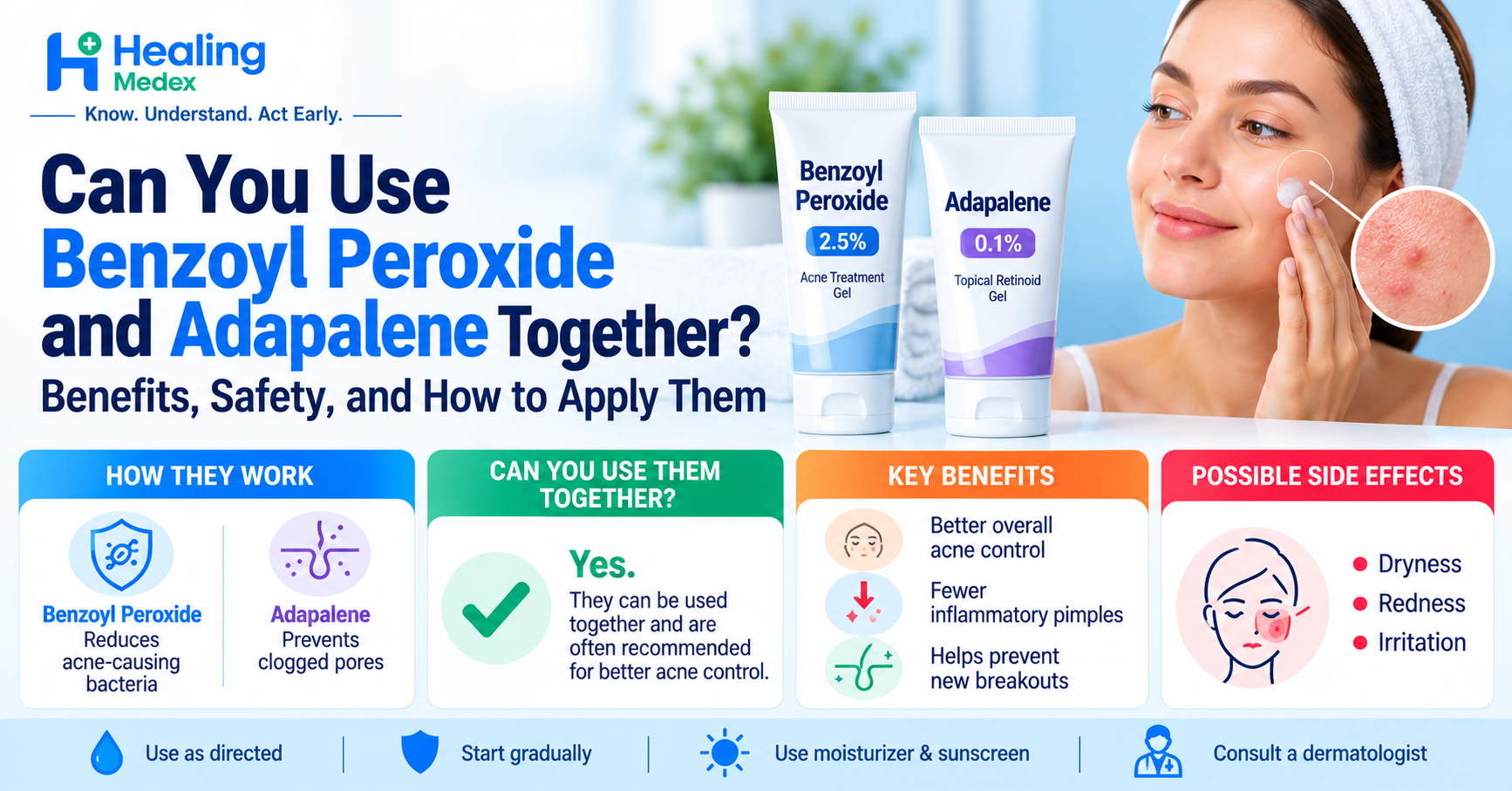
Benzoyl Peroxide and Adapalene
This is an established combination for acne treatment.
Adapalene helps prevent clogged pores, while benzoyl peroxide reduces acne-associated bacteria and inflammatory lesions.
Some prescription formulations combine both ingredients in a single gel.
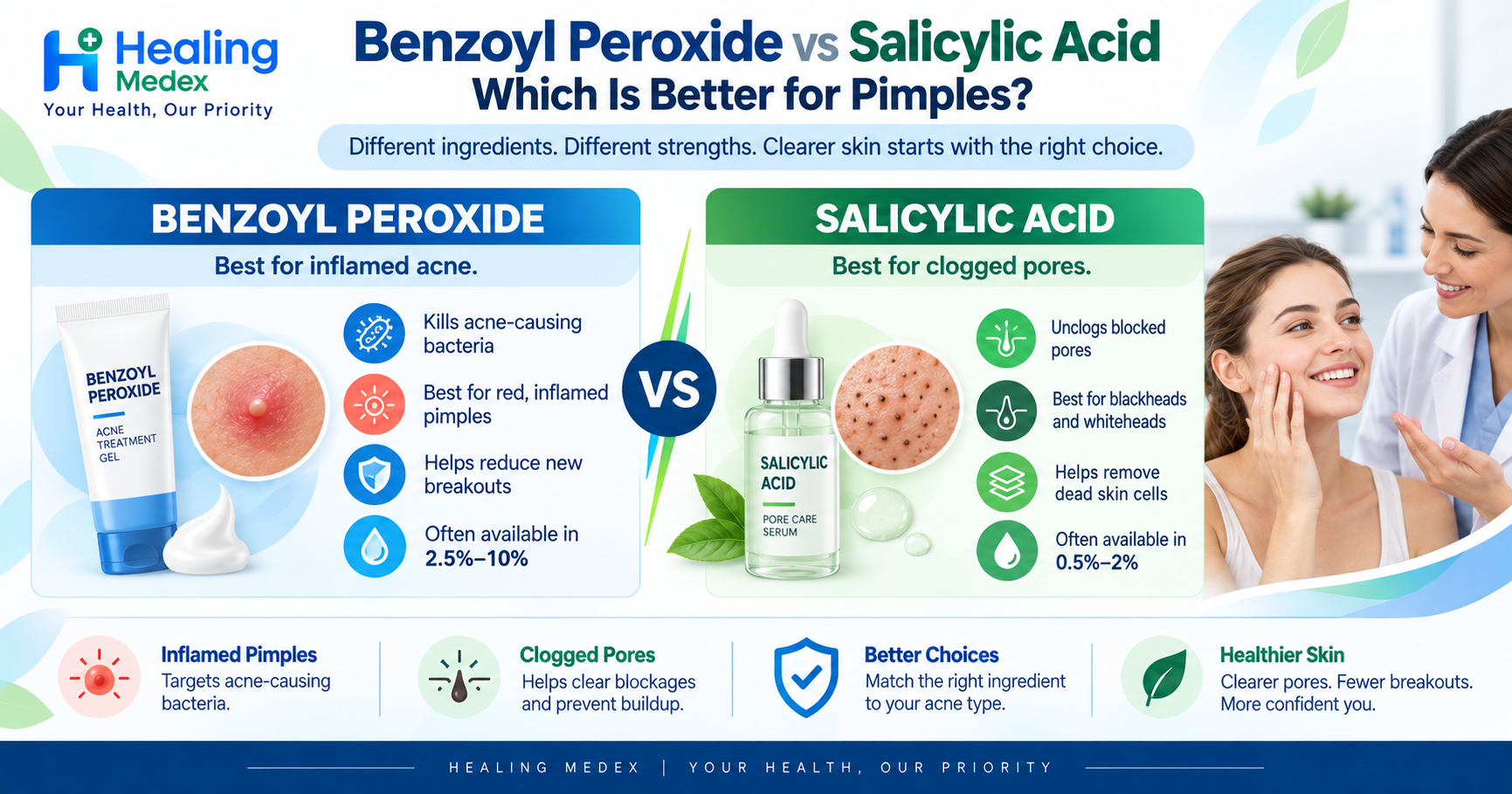
Benzoyl Peroxide and Salicylic Acid
Both ingredients can help manage acne, but they work differently.
Salicylic acid primarily helps clear blocked pores, while benzoyl peroxide is especially useful for inflammatory pimples.
Using both at the same time may increase dryness.
Benzoyl Peroxide and Topical Antibiotics
Dermatologists may prescribe benzoyl peroxide with topical antibiotics such as clindamycin.
Combining them can improve acne management and help reduce the development of antibiotic resistance.
Avoid adding multiple active treatments without considering skin tolerance or professional advice.
10. When Should You See a Dermatologist?
Over-the-counter benzoyl peroxide is helpful for many people, but it is not appropriate as the only treatment for every type of acne.
Consider consulting a dermatologist if:
Acne remains persistent after 8–12 weeks of appropriate treatment.
You have painful, deep, or cystic pimples.
Acne is causing scars or significant dark marks.
Skin irritation prevents regular treatment.
Breakouts are affecting your confidence or quality of life.
A dermatologist can recommend prescription topical treatments, combination therapy, or other medications according to acne severity.
Benzoyl Peroxide 2.5% vs 5% vs 10%: Which Should You Choose?
For many people, starting with benzoyl peroxide 2.5% is a reasonable choice.
The following comparison summarizes the main considerations.
Your situation | Suggested approach |
|---|---|
First-time benzoyl peroxide user | Start with 2.5% |
Sensitive skin | Usually prefer 2.5% |
Skin tolerates benzoyl peroxide | 2.5% or 5%, depending on product and response |
Considering 10% for faster results | Higher strength is not reliably better |
Persistent or severe acne | Seek professional advice rather than simply increasing strength |
The goal is to find a treatment that works effectively without causing unnecessary irritation.
Frequently Asked Questions (FAQs)
1. Is benzoyl peroxide 10% better than 2.5%?
Not necessarily. Clinical research has found that 2.5% can be similarly effective for inflammatory acne, while 10% may cause more irritation.
2. Is benzoyl peroxide 2.5% strong enough for acne?
Yes. Benzoyl peroxide 2.5% can effectively treat many cases of mild to moderate inflammatory acne.
3. Can I use benzoyl peroxide 5% every day?
Many people can use 5% daily if their skin tolerates it and the product instructions recommend it. Start gradually if you experience dryness or irritation.
4. Will benzoyl peroxide 10% clear pimples overnight?
No. Even high-strength benzoyl peroxide generally requires several weeks of consistent use for noticeable improvement.
5. Can I switch from 2.5% to 5% benzoyl peroxide?
Yes, but a higher strength may not improve your results. Consider whether your current treatment has been used consistently for an adequate period before changing it.
6. Which benzoyl peroxide strength is best for teenagers?
A lower concentration such as 2.5% is often a reasonable starting point, subject to product age restrictions. Younger children and those with sensitive skin should receive professional guidance.
7. Does benzoyl peroxide remove acne scars?
Benzoyl peroxide treats active acne but does not directly remove established indented or raised scars. Controlling new breakouts may help prevent further scarring.
8. Can benzoyl peroxide make acne worse?
Temporary irritation can make the skin appear red or inflamed. Persistent worsening, severe dryness, or new painful breakouts should be assessed by a healthcare professional.
Final Thoughts: Does Higher Strength Really Work Better?
When comparing benzoyl peroxide 2.5% vs 5% vs 10%, one important fact stands out: a higher percentage does not always deliver better acne results.
Research shows that lower concentrations can be similarly effective for inflammatory acne while potentially causing fewer unwanted skin reactions.
For beginners and people with sensitive skin, benzoyl peroxide 2.5% is often a practical starting point. Benzoyl peroxide 5% can also be effective, while 10% does not consistently provide additional benefit and may increase irritation.
The most effective acne routine is not necessarily the strongest one. It is the routine that suits your skin, can be used consistently, and produces improvement without excessive irritation.
At Healing Medex, we believe understanding your skincare ingredients is an important step toward making informed treatment decisions.
For more educational guides on acne, skincare ingredients, and treatment comparisons, visit Healing Medex.
Medical Disclaimer
This article is intended for educational and informational purposes only and should not replace medical advice, diagnosis, or treatment from a qualified healthcare professional. Individual treatment responses vary. Always follow product instructions and consult a dermatologist or healthcare provider before starting, combining, or changing acne medications, particularly if you have sensitive skin, severe acne, or a history of allergic reactions.