A common question is: Can you use benzoyl peroxide and adapalene together, or will combining them damage your skin?
The answer is yes. Benzoyl peroxide and adapalene can be used together, and dermatologists often recommend this combination for acne treatment. In fact, both ingredients are available in a single prescription combination gel.
However, using them incorrectly may cause dryness, redness, peeling, and irritation.
In this Healing Medex guide, we explain how these ingredients work, their benefits, how to use them safely, and what to avoid when combining them.
1. What Is Benzoyl Peroxide?
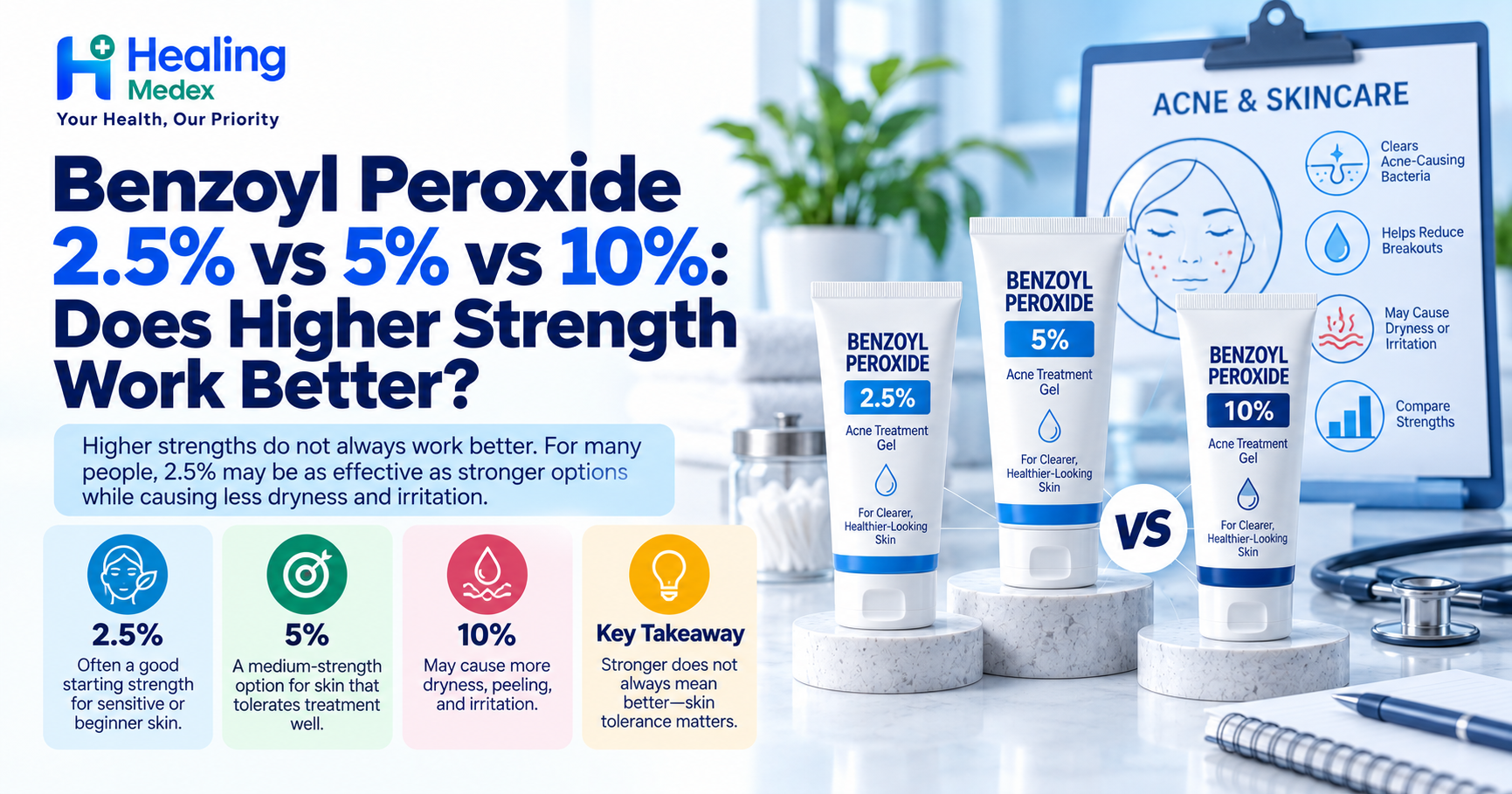
It is commonly available in concentrations such as:
Benzoyl peroxide 10%
Benzoyl peroxide is particularly useful for inflammatory acne, including red pimples and pus-filled spots.
Key benefits of benzoyl peroxide:
Reduces acne-causing bacteria.
Helps control inflammatory pimples.
Can reduce redness and swelling associated with acne.
Helps prevent new inflammatory breakouts.
Higher concentrations do not always produce better results and may cause more irritation. A lower concentration, such as 2.5%, is often a reasonable starting point.
2. What Is Adapalene?
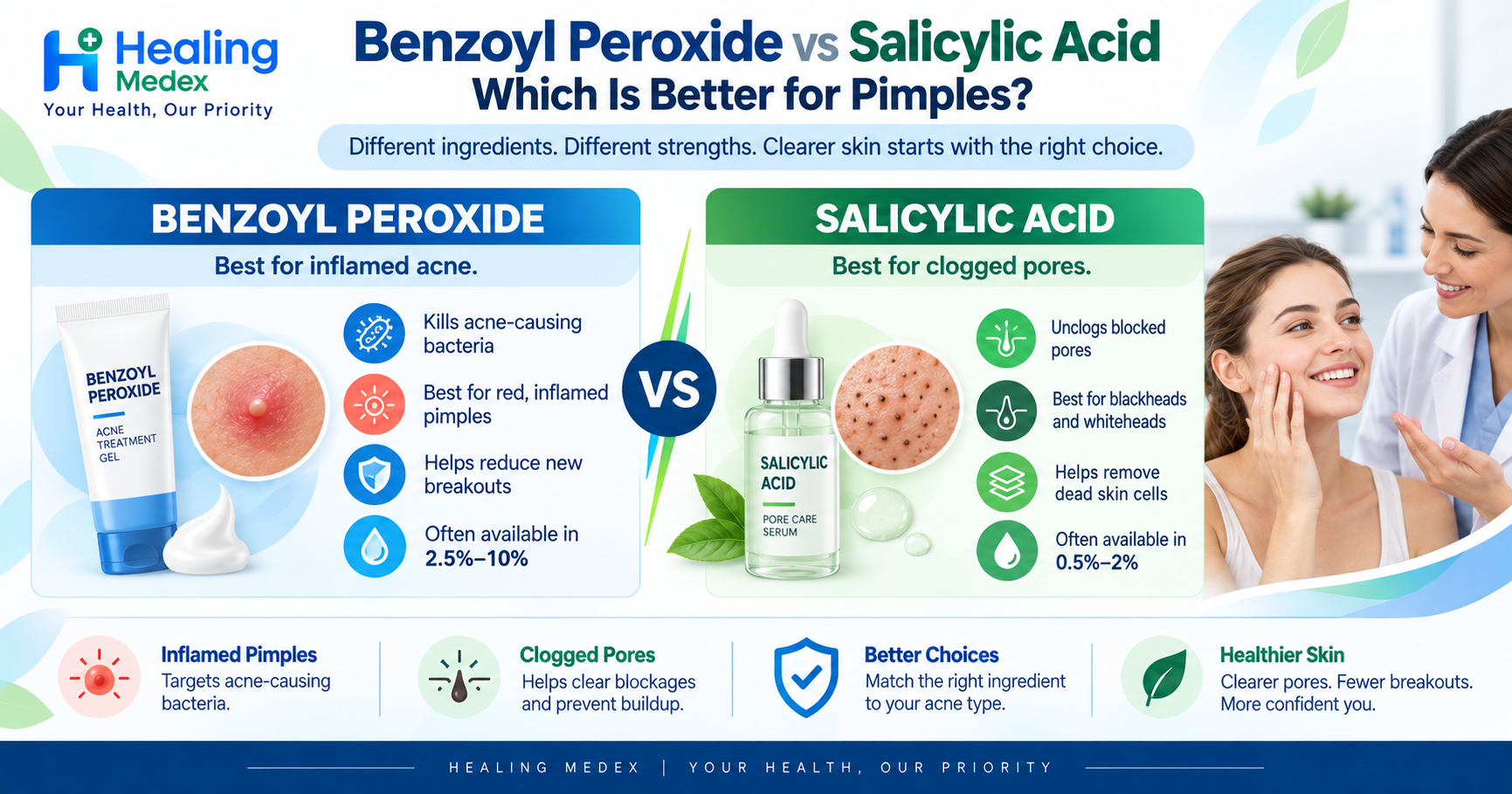
Unlike benzoyl peroxide, which primarily targets bacteria and inflammation, adapalene addresses the development of clogged pores.
Adapalene is commonly available in two strengths:
Key benefits of adapalene:
Helps prevent clogged pores.
Reduces blackheads and whiteheads.
Treats inflammatory acne.
Helps prevent new breakouts.
Supports longer-term acne control.
Adapalene usually requires consistent application over several weeks before noticeable improvement develops.
3. Can You Use Benzoyl Peroxide and Adapalene Together?
Yes. Using benzoyl peroxide and adapalene together is an established acne treatment approach.
The combination works because each ingredient addresses different factors involved in acne development.
Together, they can provide broader acne control than either ingredient alone for many patients.
The American Academy of Dermatology supports acne treatments that combine ingredients with different mechanisms of action. The UK's NICE guideline also recommends fixed-dose adapalene and benzoyl peroxide as a first-line treatment option.
However, using both ingredients may increase the risk of irritation, particularly during the first few weeks.
4. How Do Benzoyl Peroxide and Adapalene Work Together?
Both ingredients treat acne, but they target different causes.
Feature | Benzoyl peroxide | Adapalene |
|---|---|---|
Treatment type | Antibacterial acne treatment | Topical retinoid |
Main action | Reduces acne-causing bacteria | Prevents clogged pores |
Best suited for | Inflamed pimples | Blackheads, whiteheads, and inflammatory acne |
Common side effects | Dryness, redness, irritation | Peeling, dryness, irritation |
Long-term benefit | Helps control inflammatory breakouts | Helps prevent new acne lesions |
Combining these mechanisms can be particularly useful for people who experience both clogged pores and inflammatory pimples.
5. What Are the Benefits of Using Both Ingredients?
When used appropriately, the combination may offer several advantages.
1. Better overall acne control: Treating multiple causes of acne may improve results compared with using one ingredient alone.
2. Fewer inflammatory breakouts: Benzoyl peroxide helps reduce bacteria associated with acne.
3. Reduced clogged pores: Adapalene helps prevent blackheads and whiteheads from developing.
4. Prevention of new pimples: Regular application helps address acne formation before visible lesions appear.
5. Improved treatment convenience: A fixed combination gel allows both ingredients to be applied in one product.
6. Antibiotic-free treatment: This combination treats acne without relying on a topical antibiotic.
7. Long-term acne management: Adapalene and benzoyl peroxide may also be considered for maintenance treatment when appropriate.
These benefits develop gradually, and individual results vary.
6. How to Use Benzoyl Peroxide and Adapalene Together
The application method depends on whether you are using two separate products or a combination gel.
Option 1: Using separate products
A dermatologist may recommend benzoyl peroxide in the morning and adapalene at night, especially when introducing the products gradually.
Morning skincare routine
Wash your face with a gentle cleanser.
Use a non-comedogenic moisturizer.
Finish with broad-spectrum SPF 30 or higher sunscreen.
Night skincare routine
Cleanse your face gently.
Allow the skin to dry.
Apply a thin layer of adapalene over acne-prone areas, following product directions.
Apply a gentle moisturizer.
Using separate products at different times may make the routine easier to tolerate, although it does not eliminate the risk of irritation.
Option 2: Using an adapalene and benzoyl peroxide combination gel
Some prescription products combine:
Adapalene 0.3% + benzoyl peroxide 2.5%
An example is Epiduo.
Combination gels are generally applied as a thin layer to acne-affected areas once daily, according to the product label and clinician's instructions. Avoid contact with the eyes, lips, and mucous membranes.
Important: Do not add separate adapalene or benzoyl peroxide treatments on top of a combination gel unless your healthcare professional specifically recommends doing so.
7. Should Beginners Use Both Ingredients Every Day?
Not necessarily.
Starting both treatments at full frequency may cause irritation, particularly in people with sensitive skin.
One approach recommended in acne guidance is to begin with applications every other day or short-contact treatment and gradually increase frequency as tolerated.
For beginners, it is generally helpful to:
Introduce active treatments gradually.
Start with lower strengths when appropriate.
Use moisturizer consistently.
Avoid adding multiple exfoliating products.
Reduce application frequency if irritation develops, with advice from a healthcare professional.
A dermatologist can help decide whether to start with one ingredient or use the combination immediately.
8. Can Benzoyl Peroxide and Adapalene Cause Skin Irritation?
Yes. Both ingredients can cause irritation, and combining them may increase this risk.
Common side effects include:
Dryness
Redness
Mild burning or stinging
Peeling or flaking
Skin tightness
Increased sensitivity
These effects are often most noticeable during the early stages of treatment.
Mild irritation may improve as the skin adjusts. However, significant burning, swelling, blistering, or persistent irritation requires stopping the product and obtaining medical advice.
Seek urgent medical attention for symptoms of a severe allergic reaction, such as facial swelling or difficulty breathing.
Benzoyl peroxide can also bleach clothing, towels, and bedding, so take care after applying it.
9. How Long Does It Take to See Results?
Benzoyl peroxide and adapalene are not overnight acne solutions.
Typical treatment timeline
Weeks 1–2: Adjustment period
Dryness, redness, or peeling may occur as the skin adapts.
Weeks 3–4: Early improvement
Some people begin noticing fewer inflamed pimples, although progress varies.
Weeks 6–8: More visible results
Improvements in breakouts and clogged pores may become more apparent.
Weeks 8–12: Treatment assessment
A clearer picture of effectiveness usually emerges. Many guidelines recommend reviewing acne treatment at approximately 12 weeks.
These are approximate timeframes, not guaranteed results.
10. Common Mistakes to Avoid When Combining Benzoyl Peroxide and Adapalene
Even an effective acne combination may cause problems when used incorrectly.
Mistake 1: Applying too much product
Using a thicker layer does not necessarily clear acne faster and can increase irritation.
Mistake 2: Starting too many active products together
Combining benzoyl peroxide, adapalene, salicylic acid, and exfoliating acids without guidance may overwhelm sensitive skin.
Mistake 3: Skipping moisturizer
An appropriate moisturizer helps reduce dryness and supports the skin barrier.
Mistake 4: Forgetting sunscreen
Mistake 5: Applying treatment to damaged skin
Avoid application to sunburned, broken, or severely irritated skin.
Mistake 6: Expecting results within a few days
Consistent treatment over several weeks is usually necessary.
Mistake 7: Using strong scrubs
Harsh physical exfoliation can worsen redness and irritation.
Mistake 8: Increasing concentration without advice
Stronger products may cause greater irritation without providing additional benefits.
Mistake 9: Stopping treatment too quickly
Mild early dryness does not always mean the treatment is unsuitable. Persistent or severe irritation, however, should be evaluated.
Mistake 10: Ignoring persistent or scarring acne
Painful nodules, cysts, or acne that causes scarring may require prescription treatments beyond topical products.
11. Can You Use a Moisturizer with Benzoyl Peroxide and Adapalene?
Yes. Moisturizer is often an important part of a skincare routine that includes these ingredients.
Look for a moisturizer that is:
Non-comedogenic
Fragrance-free when possible
Gentle and suitable for sensitive skin
Formulated with ingredients such as ceramides, glycerin, or hyaluronic acid
Moisturizer can help reduce dryness, tightness, and discomfort.
For sensitive skin, a dermatologist may suggest adjusting the order of application or using moisturizer before and after the acne treatment, depending on the product.
12. Who Should Avoid or Use This Combination with Caution?
Additional care is needed if you have:
Very sensitive or severely irritated skin.
Eczema or another condition affecting the skin barrier.
A known allergy to either ingredient.
Severe sunburn or damaged skin.
Other prescription topical treatments that may increase irritation.
Pregnancy warning: Topical retinoids, including adapalene, should not be used during pregnancy or when planning pregnancy. Discuss safer acne treatment alternatives with a healthcare professional.
If breastfeeding, seek medical advice before using this combination and avoid applying acne medicines where an infant could come into direct contact with treated skin.
13. Frequently Asked Questions
Q1. Can I use benzoyl peroxide and adapalene on the same night?
Yes, when prescribed as a combination gel or specifically recommended by your dermatologist. Using two separate products together may increase irritation, so follow your treatment instructions.
Q2. Is adapalene 0.1% with benzoyl peroxide 2.5% effective for acne?
Q3. Should I apply benzoyl peroxide before or after adapalene?
There is no single application order suitable for every separate-product regimen. Follow your dermatologist's instructions. A fixed combination gel removes the need to decide which ingredient goes first.
Q4. Can I use niacinamide with benzoyl peroxide and adapalene?
Niacinamide is generally compatible with these ingredients and may support skin barrier function. Introduce additional products carefully to avoid irritation.
Q5. Can these ingredients help with acne scars?
They may help prevent new acne lesions and reduce the risk of future scarring by controlling acne. However, they do not reliably remove established deep or pitted acne scars.
Q6. Can I use both ingredients for body acne?
14. Final Thoughts
For many people, combining these ingredients offers broader acne control than using either one alone.
However, the best results depend on choosing an appropriate formulation, applying it consistently, and protecting the skin from excessive irritation.
If you are new to acne treatment, have sensitive skin, or experience persistent breakouts, consult a dermatologist before starting or changing your skincare routine.
With the right treatment plan, patience, and gentle skincare, acne can often be managed effectively.
Medical Disclaimer
This article is provided by Healing Medex for educational and informational purposes only. It does not replace professional medical advice, diagnosis, or treatment. Consult a qualified dermatologist or healthcare provider before using prescription acne medications, particularly if you are pregnant, planning pregnancy, breastfeeding, or have a pre-existing skin condition. Individual treatment results may vary.