Erectile dysfunction (ED) can have many possible causes, including cardiovascular disease, diabetes, hormonal problems, medications, psychological factors and lifestyle habits. In recent years, researchers have also investigated whether low vitamin D levels may be associated with erectile dysfunction.
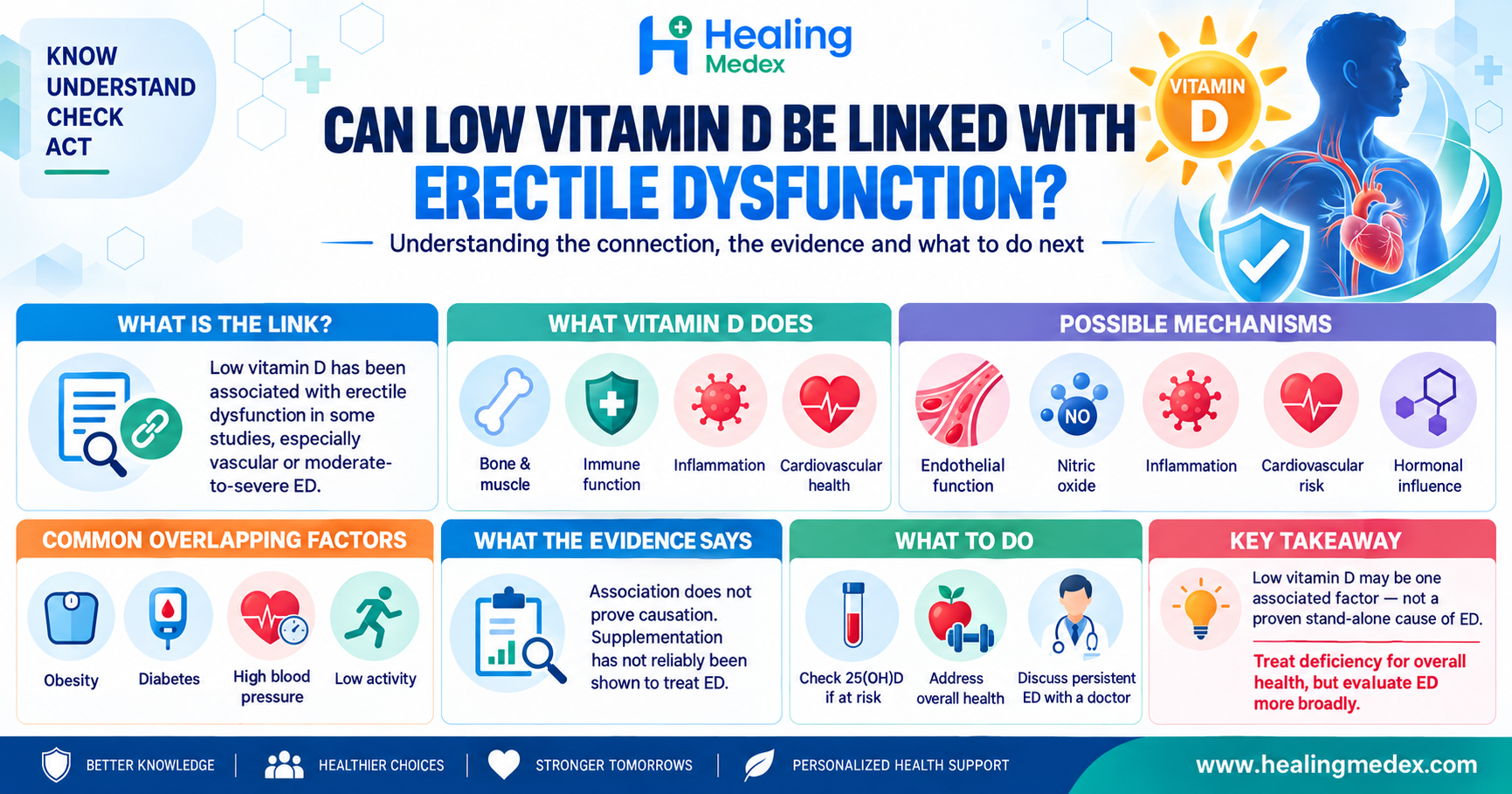
Several observational studies have found that men with erectile dysfunction tend to have lower vitamin D levels than men without ED. The association appears particularly relevant in some men with vascular or moderate-to-severe erectile dysfunction.
However, this does not mean that vitamin D deficiency directly causes ED or that taking vitamin D supplements will automatically improve erections. Erectile dysfunction is usually multifactorial, and current clinical evidence on vitamin D supplementation remains inconclusive.
What Is Vitamin D?
Vitamin D is a fat-soluble vitamin and hormone-like substance that plays important roles in:
Bone and calcium metabolism
Muscle function
Immune regulation
Inflammation
Normal cellular function
The main circulating form measured in a blood test is 25-hydroxyvitamin D [25(OH)D].
Vitamin D can be obtained through exposure of the skin to sunlight, certain foods and supplements.
A low vitamin D level is common, particularly in people who receive limited sunlight, have darker skin, spend most of their time indoors, have certain medical conditions or have inadequate dietary intake.
What Is Erectile Dysfunction?
Erectile dysfunction is the persistent difficulty in achieving or maintaining an erection firm enough for satisfactory sexual activity.
An erection depends on coordinated activity involving the:
Brain and nervous system
Hormones
Blood vessels
Penile smooth muscle
Psychological and emotional response
Healthy blood circulation is particularly important. When sexual stimulation occurs, nitric oxide helps relax smooth muscle in penile blood vessels, allowing more blood to enter erectile tissue.
Conditions that interfere with blood vessel function can therefore contribute to ED.
Can Low Vitamin D Be Linked With Erectile Dysfunction?
Research suggests that there may be an association.
A recent systematic review reported that lower vitamin D status was associated with a greater prevalence of erectile dysfunction in several studies, particularly among men with moderate-to-severe or arteriogenic ED.
However, most available studies are observational. That means researchers can identify an association but cannot prove that vitamin D deficiency itself caused erectile dysfunction.
Men with low vitamin D may also be more likely to have other conditions associated with ED, such as:
Obesity
Low levels of physical activity
Metabolic disorders
These overlapping factors make the relationship difficult to separate.
How Could Vitamin D Potentially Affect Erectile Function?
Researchers have proposed several biological mechanisms.
1. Vitamin D May Be Connected With Blood Vessel Health
Normal erections require healthy endothelial function.
The endothelium is the thin layer of cells lining the inside of blood vessels. Endothelial dysfunction can reduce the ability of blood vessels to expand appropriately.
Vitamin D deficiency has been associated with several markers of impaired endothelial function, which provides one possible explanation for the relationship between low vitamin D and vascular ED.
2. It May Influence Nitric Oxide
Nitric oxide is one of the most important molecules involved in producing an erection.
During sexual stimulation, nitric oxide helps penile blood vessels and smooth muscle relax. This increases blood flow into the penis.
Laboratory and physiological research suggests that vitamin D may influence nitric oxide production and endothelial nitric oxide pathways.
Therefore, inadequate vitamin D has been proposed as one factor that could contribute to impaired vascular relaxation.
This remains a proposed biological mechanism rather than proof that vitamin D supplements treat ED.
3. Vitamin D Deficiency May Be Associated With Inflammation
Chronic inflammation and oxidative stress can damage blood vessels and impair endothelial function.
Vitamin D has roles in immune and inflammatory regulation. Researchers have therefore proposed that inadequate vitamin D may indirectly affect erectile function through increased inflammation or oxidative stress.
Again, this relationship is complex and does not establish vitamin D deficiency as a single cause of erectile dysfunction.
4. Vitamin D and Cardiovascular Health Are Closely Connected
ED and cardiovascular disease share many risk factors.
These include:
Hypertension
Obesity
Smoking
Physical inactivity
Vascular disease
Because erections depend heavily on adequate blood flow, vascular dysfunction can appear as erectile problems.
Low vitamin D is frequently seen alongside several cardiometabolic conditions, which may partly explain why vitamin D deficiency and ED often occur together.
5. Vitamin D May Have an Indirect Relationship With Hormonal Health
Researchers have also explored relationships between vitamin D and reproductive hormones, including testosterone.
However, the evidence does not establish that simply increasing vitamin D will meaningfully increase testosterone or resolve hormone-related erectile dysfunction in most men.
Hormonal causes of ED should therefore be investigated separately when clinically appropriate.
What Does the Research Show?
Multiple observational studies have reported lower vitamin D concentrations among men with erectile dysfunction.
A recent systematic review concluded that vitamin D deficiency was associated with a higher prevalence of ED across several studies, including after adjustment for some lifestyle, cardiovascular and hormonal factors.
The relationship may be particularly noticeable among men with moderate-to-severe ED or impaired penile arterial blood flow.
However, researchers also highlighted substantial limitations:
Many studies were relatively small.
Definitions of vitamin D deficiency differed between studies.
ED assessment methods varied.
Many studies were cross-sectional.
Other health conditions could influence both vitamin D levels and erectile function.
Randomized supplementation trials have produced inconsistent results.
For these reasons, a causal relationship has not been established.
Can Vitamin D Supplements Improve Erectile Dysfunction?
This is where an important distinction must be made.
Having low vitamin D associated with ED does not necessarily mean that taking vitamin D will treat ED.
One large randomized placebo-controlled study published in 2024 evaluated three years of vitamin D supplementation in older men.
The prevalence of erectile dysfunction was approximately 58.8% in the vitamin D group and 59.0% in the placebo group, and researchers found no evidence that vitamin D supplementation prevented or improved ED.
The study concluded that supplementing older men with vitamin D was unlikely to prevent or improve erectile dysfunction.
Smaller studies have reported possible improvements in certain populations, but the overall evidence remains inconsistent.
Therefore, vitamin D should not be considered a replacement for established ED treatments.
Should Men With ED Have Their Vitamin D Checked?
Vitamin D testing may be reasonable when a healthcare professional suspects deficiency based on symptoms, lifestyle, medical history or other risk factors.
A blood test measuring 25-hydroxyvitamin D [25(OH)D] is generally used to assess vitamin D status.
Testing may be particularly relevant for people who:
Have limited sunlight exposure
Have nutritional deficiencies
Have osteoporosis or poor bone health
Have malabsorption disorders
Have certain kidney or liver conditions
Take medications affecting vitamin D metabolism
Have other clinical risk factors for vitamin D deficiency
Whether vitamin D should routinely be measured in every person with ED remains uncertain.
If Vitamin D Is Low, Should It Be Treated?
A confirmed vitamin D deficiency should generally be discussed with a healthcare professional and managed for overall health, even if improving erections is not guaranteed.
Treatment may include:
Appropriate vitamin D supplementation
Safe sunlight exposure where appropriate
Vitamin-D-containing foods
Management of conditions contributing to deficiency
The correct supplement dose depends on the person's vitamin D concentration, age, diet, medical conditions and other factors.
Taking very large amounts of vitamin D without medical supervision is not recommended because excessive vitamin D can cause toxicity and abnormally high blood calcium.
Foods That Provide Vitamin D
Dietary sources can include:
Fatty fish such as salmon, sardines and mackerel
Egg yolks
Fortified milk
Fortified plant-based drinks
Fortified cereals
Some mushrooms
Food alone may not always correct significant deficiency, so testing and individualized treatment can be important.
What Else Should Be Checked When Someone Has ED?
Vitamin D is only one possible piece of the picture.
Persistent erectile dysfunction should prompt consideration of other common causes and risk factors, including:
Cardiovascular Health
ED can sometimes accompany vascular disease because penile arteries depend on healthy blood flow.
Assessment may include blood pressure, cardiovascular risk factors and cholesterol.
Diabetes
High blood glucose can damage nerves and blood vessels required for normal erections.
Testosterone and Other Hormones
Men with symptoms suggestive of testosterone deficiency may require hormonal assessment.
Medications
Some blood pressure medicines, antidepressants and other medications can affect erectile function.
Medication should not be discontinued without medical advice.
Smoking and Alcohol
Smoking damages blood vessels, while excessive alcohol consumption can interfere with sexual function.
Obesity and Physical Inactivity
Both are associated with cardiovascular dysfunction and increased ED risk.
Psychological Factors
Stress, anxiety, depression and relationship difficulties can contribute to or worsen ED.
Often, physical and psychological factors occur simultaneously.
How Is Erectile Dysfunction Usually Treated?
Treatment depends on its cause.
Options may include:
Improving cardiovascular risk factors
Regular physical activity
Reducing excessive alcohol consumption
Managing diabetes or high blood pressure
Reviewing medications
Psychological or relationship therapy where appropriate
Treating clinically confirmed hormone deficiencies
Prescription ED medicines
Common oral ED medicines include PDE5 inhibitors such as sildenafil and tadalafil. They improve the erectile response by enhancing nitric-oxide-related blood flow pathways but require appropriate medical assessment because they are not suitable for everyone.
Vitamin D supplementation should not be viewed as an alternative to proper evaluation and evidence-based ED treatment.
When Should You See a Healthcare Professional?
Occasional difficulty achieving an erection can happen and does not necessarily indicate a medical condition.
However, seek medical advice if erectile problems:
Occur repeatedly
Continue for several weeks or months
Are becoming progressively worse
Are associated with reduced sexual desire
Occur alongside symptoms of low testosterone
Are accompanied by diabetes, hypertension or cardiovascular disease
Cause significant anxiety or relationship difficulties
ED can occasionally be an early sign of an underlying cardiovascular or metabolic problem, so persistent symptoms are worth discussing rather than simply treating on your own.
The Bottom Line
Low vitamin D can be associated with erectile dysfunction, but current research does not prove that vitamin D deficiency directly causes ED.
There are biologically plausible connections involving endothelial health, nitric oxide, inflammation and cardiovascular risk. Observational studies have also found lower vitamin D levels more frequently among some men with ED.
However, association does not equal causation.
Most importantly, randomized clinical evidence has not demonstrated that vitamin D supplementation reliably prevents or treats erectile dysfunction.
If a person has both erectile dysfunction and confirmed vitamin D deficiency, correcting the deficiency may still be appropriate for general health. Persistent ED, however, deserves a broader evaluation for cardiovascular, metabolic, hormonal, medication-related and psychological factors.
Key Takeaway
Low vitamin D may be one associated factor rather than a stand-alone cause of erectile dysfunction. Correct vitamin D deficiency when medically appropriate, but do not rely on vitamin D supplements alone to treat persistent ED.