Sildenafil is a widely used medicine for treating erectile dysfunction (ED) in adult men. It belongs to a group of medicines called phosphodiesterase type 5 (PDE5) inhibitors, which help improve blood flow to the penis during sexual stimulation.
Sildenafil is available in different strengths, commonly including 25 mg, 50 mg, and 100 mg. Among these, 50 mg and 100 mg are frequently prescribed for erectile dysfunction.
But what is the actual difference between sildenafil 50 mg and 100 mg? Does 100 mg work better? Does it last longer? And which dose is appropriate?
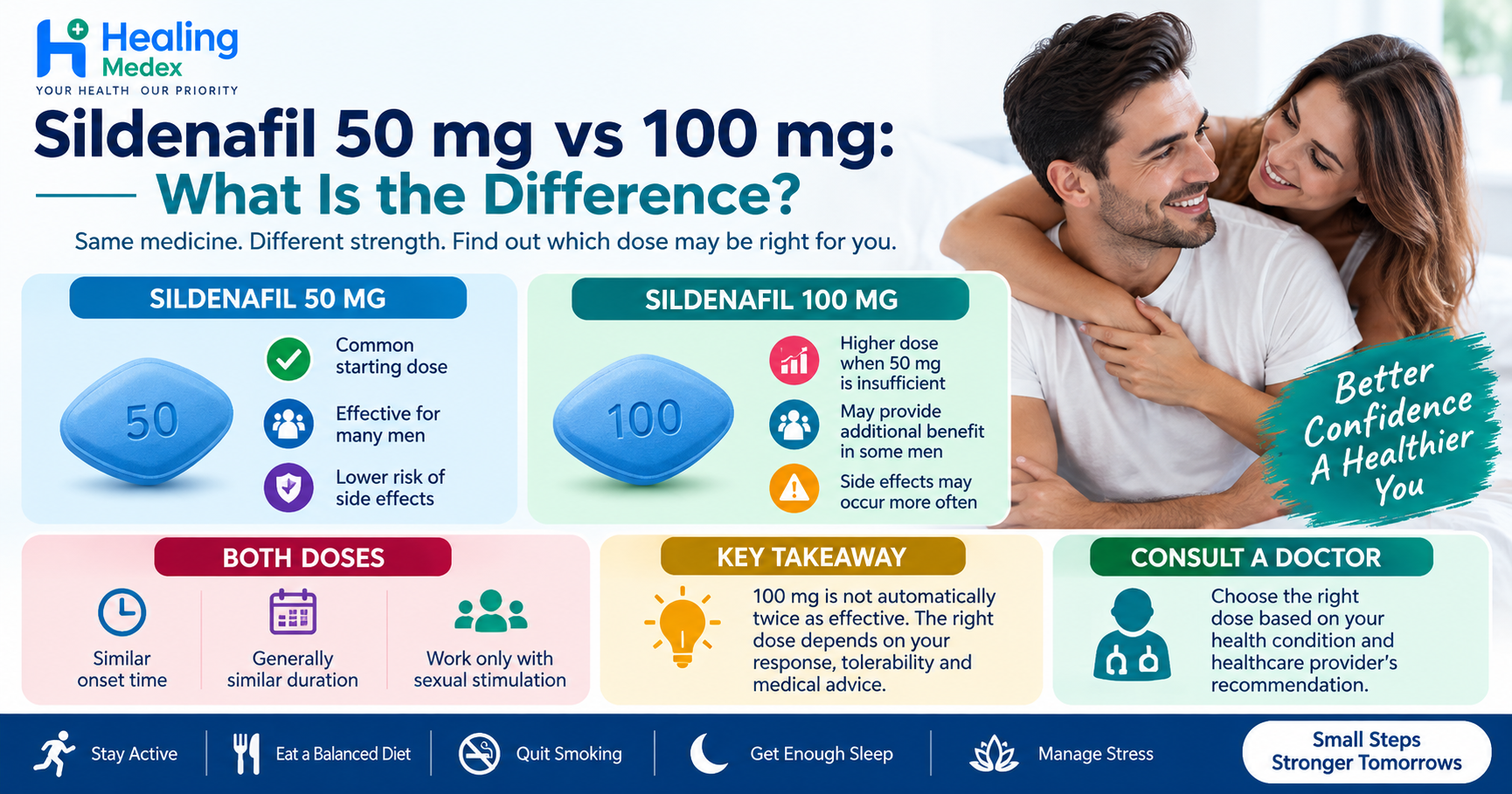
The main difference is the amount of sildenafil in each tablet. While 100 mg may provide a stronger response for some men, it can also increase the likelihood of certain side effects. The appropriate dose should therefore be selected based on effectiveness, tolerability, medical history, and a healthcare professional’s recommendation.
What Is Sildenafil?
Sildenafil is a PDE5 inhibitor used to treat erectile dysfunction. It works by supporting the natural process that increases blood flow to the penis when a man becomes sexually stimulated.
Sildenafil does not automatically cause an erection. Sexual stimulation is still necessary for the medicine to work.
For most patients, prescribing information recommends a starting dose of 50 mg taken as needed approximately one hour before sexual activity. Depending on effectiveness and tolerability, a healthcare provider may decrease the dose to 25 mg or increase it to a maximum recommended dose of 100 mg. Sildenafil should generally not be taken more than once per day.
Sildenafil 50 mg vs 100 mg: Quick Comparison
Feature Sildenafil 50 mg Sildenafil 100 mg Amount of sildenafil 50 mg 100 mg Typical role Common starting dose Higher dose when a lower dose is insufficient Effectiveness Effective for many men May provide additional benefit in some men Onset Usually similarUsually similar Duration Generally similar Generally similar Risk of side effects Lower than 100 mg for several adverse effects Some adverse effects occur more frequently Maximum daily frequencyUsually once daily Usually once dailyShould dose be increased without medical advice?NoNo
The 100 mg tablet contains twice as much sildenafil as the 50 mg tablet, but that does not mean it is automatically twice as effective or lasts twice as long.
What Is Sildenafil 50 mg?
Sildenafil 50 mg is the recommended starting dose for many adults being treated for erectile dysfunction.
It is commonly taken approximately one hour before anticipated sexual activity, although prescribing information permits administration from about 30 minutes to four hours beforehand.
For many men, 50 mg provides enough improvement in erectile function without requiring a higher dose.
A healthcare provider may keep a patient at 50 mg when:
erections improve sufficiently with the dose
side effects are mild or absent
the patient does not require a stronger dose
the patient’s health and other medications make 50 mg appropriate
Using the lowest effective dose can help balance effectiveness with tolerability.
What Is Sildenafil 100 mg?
Sildenafil 100 mg is the maximum recommended single dose for erectile dysfunction under standard prescribing guidance.
A healthcare professional may consider increasing sildenafil from 50 mg to 100 mg when 50 mg does not produce an adequate response and the medicine is otherwise tolerated.
However, 100 mg should not simply be chosen because it sounds stronger.
Increasing the dose can increase exposure to sildenafil and may make certain adverse effects more likely.
Is Sildenafil 100 mg More Effective Than 50 mg?
It can be more effective for some men, but not everyone needs the higher dose.
Clinical trials included in sildenafil prescribing information demonstrated improvement across approved doses. In four fixed-dose clinical studies, approximately 74% of patients taking 50 mg and 82% taking 100 mg reported improved erections, compared with 24% receiving placebo. These figures represent clinical-trial populations and should not be interpreted as a guarantee of an individual’s response.
The difference also illustrates an important point: doubling the dose from 50 mg to 100 mg did not double the percentage of patients who reported improvement.
If sildenafil 50 mg already provides satisfactory results, taking 100 mg may provide little additional benefit while potentially increasing adverse effects.
Does Sildenafil 100 mg Work Faster Than 50 mg?
Not necessarily.
Both strengths contain the same active ingredient and have similar pharmacological characteristics. Increasing sildenafil from 50 mg to 100 mg is primarily intended to increase the drug exposure and potentially strengthen the therapeutic response — not to make the medicine work twice as fast.
Sildenafil reaches maximum blood concentrations approximately 30 to 120 minutes after administration when taken in a fasted state, with a median of around 60 minutes.
Individual response may vary depending on factors such as:
food
metabolism
age
other medications
medical conditions
psychological factors
degree of sexual stimulation
Does 100 mg Sildenafil Last Longer Than 50 mg?
Usually, the biggest difference between the doses is strength of exposure rather than duration.
Both 50 mg and 100 mg contain sildenafil, whose sildenafil and active metabolite terminal half-lives are approximately four hours.
Therefore, taking 100 mg should not be viewed as a way to make sildenafil last twice as long.
The duration experienced by an individual can vary, but a higher dose does not proportionally extend the medicine’s effective window.
Sildenafil 50 mg vs 100 mg Side Effects
Both doses can produce similar types of side effects. However, clinical studies show that some adverse reactions became more frequent at higher doses.
For example, fixed-dose clinical trials reported:
Side Effect Sildenafil 50 mg Sildenafil 100 mgHeadache21%28%Flushing19%18%Indigestion/dyspepsia9%17%Abnormal vision2%11%Nasal congestion4%9%Back pain4%4%Nausea3%3%Dizziness4%3%
These numbers come from controlled clinical trials and individual experiences may differ.
Common sildenafil side effects can include:
headache
facial flushing
indigestion
nasal congestion
dizziness
nausea
temporary changes in vision
muscle or back discomfort
A person experiencing troublesome side effects should discuss them with a healthcare professional rather than adjusting the dose independently.
Should You Start With Sildenafil 50 mg or 100 mg?
For most patients, official prescribing information recommends 50 mg as the usual starting dose.
The dose can then be adjusted according to the individual’s response and tolerability.
Starting immediately with 100 mg is not appropriate for everyone.
In fact, some people may require an even lower starting dose of 25 mg, including certain older adults, people with severe kidney impairment or liver impairment, and individuals taking medications that significantly increase sildenafil concentrations.
The appropriate dose therefore depends on much more than the severity of erectile dysfunction.
When Might a Doctor Consider Increasing From 50 mg to 100 mg?
A healthcare professional may consider 100 mg when:
50 mg has been tried correctly
the response at 50 mg remains inadequate
side effects at 50 mg are acceptable
there are no important contraindications or interactions
the patient’s overall cardiovascular and medical status makes the higher dose appropriate
Before assuming that 50 mg has failed, it may also be useful for a healthcare professional to assess whether the medicine was being used correctly.
Factors such as insufficient sexual stimulation, timing, a large meal, anxiety, or underlying medical problems can affect the response.
Can Food Affect Sildenafil?
Yes.
Sildenafil can be taken with or without food. However, a high-fat meal can slow absorption. Prescribing information reports that a high-fat meal delayed the time to maximum concentration by approximately 60 minutes and reduced the peak concentration by about 29%.
This means sildenafil may appear to work more slowly when taken following a heavy or high-fat meal.
Can You Take Two Sildenafil 50 mg Tablets to Make 100 mg?
Two 50 mg tablets contain the same total amount of sildenafil as 100 mg, but patients should not increase their prescribed dose on their own.
Whether 100 mg is medically appropriate depends on factors including:
current medications
blood pressure
heart health
kidney function
liver function
previous response to sildenafil
previous side effects
The maximum recommended dose does not mean that everyone should take that amount.
Who Should Be Especially Careful With Sildenafil?
Sildenafil can interact with several medicines and medical conditions.
Nitrate Medicines
Sildenafil must not be used with nitrate medicines, such as certain treatments for angina, because the combination can cause a potentially dangerous fall in blood pressure.
This includes nitrate-containing recreational drugs sometimes called “poppers.”
Riociguat
Sildenafil should not be combined with the guanylate cyclase stimulator riociguat, because the combination can also produce excessive blood-pressure lowering.
Alpha-Blockers
Alpha-blockers used for conditions such as prostate enlargement or high blood pressure can interact with sildenafil and increase the risk of symptomatic low blood pressure.
Prescribing information recommends that patients taking an alpha-blocker be stable on that treatment and that sildenafil generally be initiated at its lowest dose when the medicines are used together.
Other Medicines
Certain medicines that affect the CYP3A4 enzyme can substantially increase sildenafil concentrations. Examples include some antiviral and antifungal medicines.
Always provide a healthcare professional with a complete list of prescription medicines, over-the-counter products and supplements before using sildenafil.
Serious Side Effects That Require Medical Attention
Although uncommon, sildenafil can cause serious adverse effects.
Seek immediate medical assistance if an erection lasts longer than four hours, since prolonged erections can damage penile tissue if untreated.
Sildenafil should also be stopped and prompt medical advice obtained for symptoms including:
sudden loss or significant decrease in vision
sudden decrease or loss of hearing
ringing in the ears accompanied by hearing changes
severe dizziness or fainting
chest pain during sexual activity
Rare cases of sudden vision or hearing problems have been reported in association with PDE5 inhibitors, although a direct causal relationship is not always established.
Sildenafil 50 mg vs 100 mg: Which Is Better?
There is no single dose that is best for every person.
Sildenafil 50 mg may be preferable when:
it provides satisfactory erections
side effects are minimal
the patient is beginning sildenafil treatment
there is no need for a higher dose
Sildenafil 100 mg may be considered when:
50 mg produces an inadequate response
50 mg has been used correctly
the medicine is well tolerated
a healthcare professional considers 100 mg appropriate
The objective is not to take the strongest available tablet. The objective is to find the lowest dose that provides adequate benefit with acceptable side effects.
Frequently Asked Questions
1. Is sildenafil 100 mg twice as strong as 50 mg?
It contains twice the amount of active sildenafil, but this does not mean it will provide twice the clinical benefit. Response varies between individuals.
2. Is 100 mg sildenafil better for severe ED?
Some men who have an inadequate response to 50 mg may benefit from 100 mg, but ED severity alone does not determine the correct dose. A healthcare professional should evaluate the underlying cause, response to treatment, medications and medical history.
3. Does sildenafil 100 mg last longer?
Not necessarily. Both doses contain the same medicine and have similar pharmacological duration. A higher dose mainly increases drug exposure rather than doubling how long sildenafil works.
4. Can I take sildenafil 100 mg every day?
The maximum recommended dosing frequency for sildenafil used as needed for erectile dysfunction is once per day. That does not mean 100 mg every day is appropriate for every patient.
5. What happens if 100 mg sildenafil does not work?
Do not take additional sildenafil beyond the prescribed maximum. Persistent erectile dysfunction despite correct use should be discussed with a healthcare professional. Other causes or treatment options may need to be evaluated.
6. Can I switch from 50 mg to 100 mg myself?
No. Dose changes should be discussed with a healthcare professional, particularly because higher sildenafil exposure may increase side effects and interact with other medicines.
Final Thoughts
The primary difference between sildenafil 50 mg and sildenafil 100 mg is the amount of active medicine.
For many men, 50 mg is the standard starting dose and provides an adequate response. If the response is insufficient and the medicine is well tolerated, a healthcare provider may consider increasing the dose to 100 mg, which is the maximum recommended single dose for erectile dysfunction.
A higher dose does not automatically mean faster action, significantly longer duration, or twice the effectiveness. It may, however, increase the likelihood of certain side effects.
For this reason, sildenafil should always be used at the dose recommended by a qualified healthcare professional.