What Is Clenbuterol?
Clenbuterol is a long-acting beta-2 adrenergic receptor agonist.
Beta-2 agonists stimulate receptors found in several tissues, particularly the smooth muscle surrounding the airways. Activation of these receptors can relax airway muscles, which is why clenbuterol has historically been used as a bronchodilator for asthma or other breathing disorders in some countries.
Its pharmacological action is closer to other beta-2 agonist bronchodilators than to testosterone or anabolic steroids.
Clenbuterol may also influence:
Heart rate
Blood pressure
Energy expenditure
Fat metabolism
Blood glucose
Blood potassium
Skeletal muscle
These systemic effects are one reason misuse can become dangerous.
Is Clenbuterol an Anabolic Steroid?
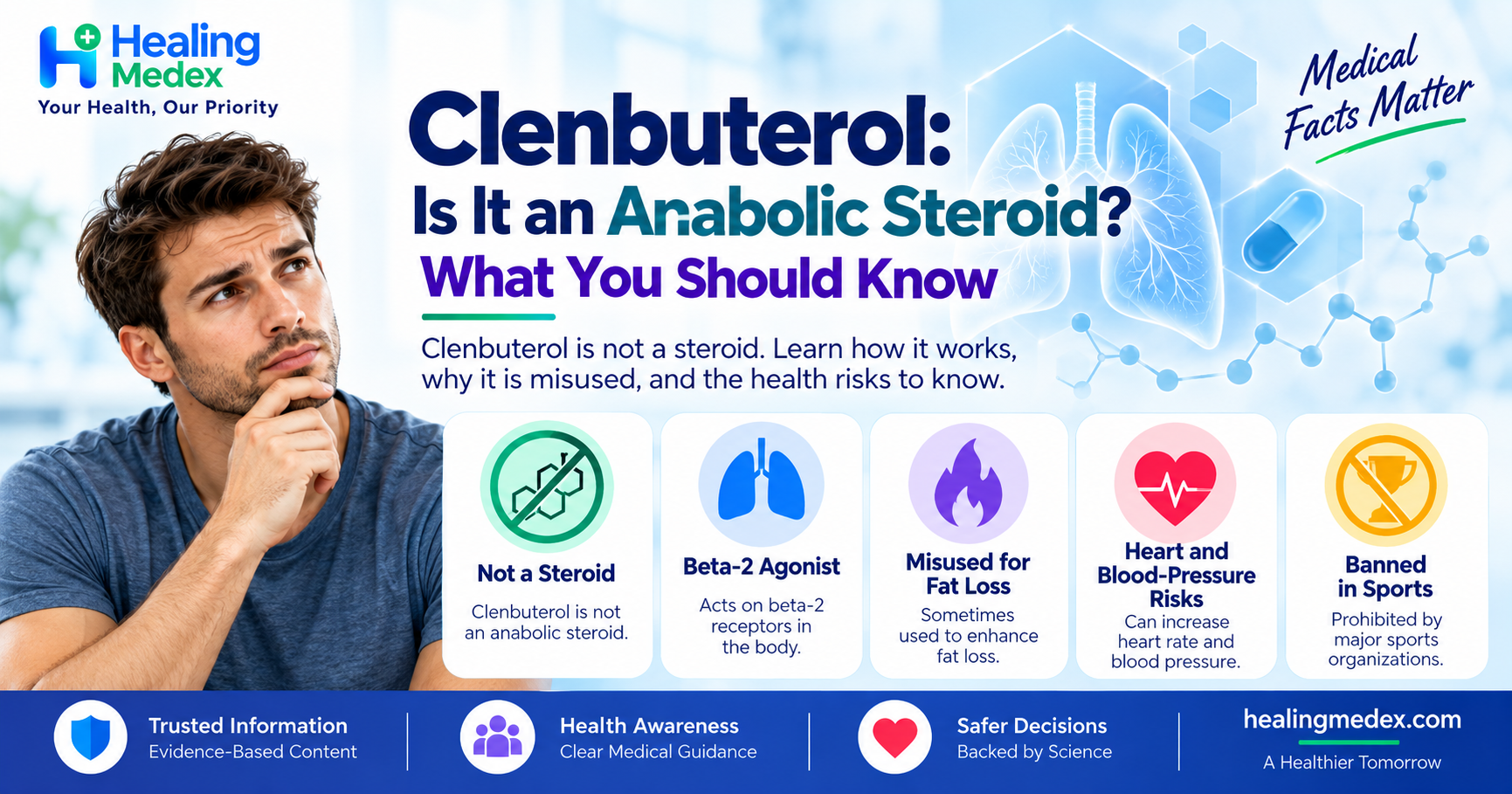
No. Clenbuterol is not an anabolic-androgenic steroid.
Clenbuterol instead works mainly by stimulating beta-2 adrenergic receptors.
Therefore, although both clenbuterol and anabolic steroids may sometimes be discussed in bodybuilding communities, their mechanisms of action are fundamentally different.
Clenbuterol vs Anabolic Steroids
Feature | Clenbuterol | Anabolic Steroids |
|---|---|---|
Drug class | Beta-2 adrenergic agonist | |
Testosterone derivative | No | Usually testosterone or steroid-related |
Main receptor | Beta-2 adrenergic receptor | Androgen receptor |
Originally developed for | Bronchodilation | Hormonal/medical indications vary |
May affect muscle tissue | Potentially | Yes |
Common non-medical purpose | Fat loss/bodybuilding | Muscle and strength enhancement |
Cardiovascular risks | Yes | Yes |
Testosterone suppression through typical androgenic feedback | Not its primary mechanism | Common with exogenous AAS |
This distinction is important because calling clenbuterol a "steroid" gives an inaccurate impression of how the substance actually works.
Why Is Clenbuterol Sometimes Called an Anabolic Agent?
There is an important difference between an anabolic steroid and an anabolic agent.
Research in animals has demonstrated that clenbuterol can increase skeletal muscle mass and reduce fat under certain experimental conditions. Beta-2 receptor activation appears to contribute to these effects. However, findings from animal experiments cannot simply be translated into safe or effective bodybuilding use in humans.
The World Anti-Doping Agency's 2026 Prohibited List places clenbuterol under S1.2 "Other Anabolic Agents." It is listed separately from S1.1 anabolic-androgenic steroids.
So the most accurate description is:
Clenbuterol is not an anabolic steroid, but it is classified as an anabolic agent in anti-doping regulations.
Why Do Bodybuilders Use Clenbuterol?
Non-medical clenbuterol use is commonly associated with attempts to:
Reduce body fat
Increase metabolic rate
Preserve lean tissue during calorie restriction
Achieve a more defined physique
Improve perceived athletic performance
Its stimulant-like metabolic effects have contributed to a reputation as a "fat burner."
However, the evidence supporting meaningful performance-enhancing or bodybuilding benefits in humans is much less established than online claims often suggest.
A systematic review examining reported clenbuterol adverse events among athletes found serious cardiovascular complications while also noting the lack of convincing evidence supporting its performance-enhancing usefulness.
Potential physique changes therefore need to be weighed against potentially severe health consequences.
Does Clenbuterol Burn Fat?
Clenbuterol can stimulate adrenergic pathways involved in energy expenditure and fat metabolism.
That biological effect is one reason it became popular in bodybuilding and weight-loss circles.
However, this does not mean clenbuterol is a safe or medically appropriate weight-loss treatment.
The doses and products used outside medical supervision can be unpredictable, and cardiovascular stimulation can occur alongside any metabolic effects.
Poison Control notes that clenbuterol is frequently misused for possible fat-burning and anabolic effects despite serious toxicity being reported.
Does Clenbuterol Build Muscle?
This question requires more nuance.
Animal research has demonstrated increases in skeletal muscle mass with clenbuterol exposure. These effects appear to involve beta-2 receptor stimulation rather than androgen-receptor activation.
But strong evidence demonstrating that clenbuterol safely produces meaningful muscle growth in humans is lacking.
Consequently, animal findings should not be interpreted as proof that clenbuterol is an effective or safe muscle-building drug for people.
What Are the Common Side Effects of Clenbuterol?
Because clenbuterol stimulates the adrenergic nervous system, side effects may include:
Rapid heartbeat
Heart palpitations
Tremor or shaking
Anxiety or restlessness
Sweating
Headache
Nausea
Muscle cramps
Changes in blood pressure
It may also produce important metabolic abnormalities such as low potassium levels (hypokalemia) and elevated blood glucose (hyperglycemia).
The intensity of these effects can vary substantially between individuals.
Can Clenbuterol Affect the Heart?
Cardiovascular complications are among the biggest concerns surrounding clenbuterol misuse.
Published reports have associated clenbuterol exposure with:
Persistent tachycardia
Supraventricular tachycardia
Atrial fibrillation
Abnormal blood pressure
Chest pain
Myocardial ischemia
Myocardial injury
Cardiomyopathy
Heart attack
Cardiac arrest
A 2023 systematic review of athlete case reports found cardiac complications to be particularly prominent among reported serious adverse events.
These complications can occur even in relatively young or apparently healthy individuals.
Can Clenbuterol Lower Potassium?
Yes.
Beta-2 receptor stimulation can shift potassium from the bloodstream into cells, causing hypokalemia.
Low potassium may contribute to:
Muscle weakness
Muscle cramps
Palpitations
Abnormal heart rhythms
Clenbuterol toxicity reports frequently describe hypokalemia together with tachycardia and hyperglycemia.
This combination can place additional stress on the cardiovascular system.
Does Clenbuterol Suppress Natural Testosterone?
Clenbuterol does not work through the androgen receptor in the same way as anabolic-androgenic steroids.
Therefore, it should not automatically be assumed to cause the same direct hypothalamic-pituitary-gonadal suppression associated with exogenous testosterone or anabolic steroid exposure.
However, many people who misuse clenbuterol also use anabolic steroids or other performance-enhancing drugs simultaneously. This makes hormone changes difficult to attribute to clenbuterol itself.
Using multiple substances can also increase overall health risk.
Is Clenbuterol Approved for Human Use?
Regulatory status differs between countries.
In the United States, clenbuterol is not FDA-approved for human use. The FDA does list an approved clenbuterol hydrochloride veterinary product, Ventipulmin, for horses.
Clenbuterol has been used or approved as a bronchodilator for humans in some countries outside the United States.
People should therefore check the regulations that apply in their own country rather than assuming that online availability means a product is medically approved.
Is Clenbuterol Banned in Sports?
Yes, under World Anti-Doping Agency rules.
The 2026 WADA Prohibited List includes clenbuterol under S1.2 Other Anabolic Agents.
Competitive athletes should therefore be particularly cautious about products claiming to contain clenbuterol or supplements that could potentially be contaminated with prohibited substances.
Is Clenbuterol Safer Than Anabolic Steroids?
It is not useful to assume that clenbuterol is safe simply because it is not technically a steroid.
The substances produce different risk profiles.
Anabolic steroids may cause hormonal suppression, fertility problems, lipid abnormalities, cardiovascular changes, liver effects depending on the compound, and other androgen-related complications.
Clenbuterol can produce intense adrenergic and cardiovascular stimulation and potentially dangerous metabolic abnormalities.
In other words:
Different mechanism does not mean lower risk.
Both categories can cause serious harm when misused.
What Are the Signs of Possible Clenbuterol Toxicity?
Potential warning signs include:
Very rapid or irregular heartbeat
Severe palpitations
Chest pain
Fainting
Severe tremor
Shortness of breath
Confusion or severe agitation
Seizure
Severe weakness
Serious toxicity has been associated with myocardial injury, arrhythmias, cardiogenic shock, seizures, and cardiac arrest.
Someone experiencing severe symptoms after suspected clenbuterol exposure should seek urgent medical attention rather than trying to manage the problem independently.
Frequently Asked Questions
1.Is clenbuterol a steroid?
No. Clenbuterol is a beta-2 adrenergic agonist, not an anabolic-androgenic steroid.
2.Is clenbuterol anabolic?
It has demonstrated anabolic effects in animal studies and is categorized by WADA as an "other anabolic agent." That does not make it an anabolic steroid or establish safe muscle-building benefits in humans.
3.Is clenbuterol a fat burner?
Clenbuterol can influence metabolic and fat-mobilizing pathways, which explains its non-medical use for weight loss. However, it is not a harmless fat-burning supplement, and serious cardiovascular toxicity has been reported.
4.Is clenbuterol the same as testosterone?
No. Testosterone is an androgenic steroid hormone that acts primarily through androgen receptors. Clenbuterol stimulates beta-2 adrenergic receptors.
5.Can clenbuterol cause heart problems?
Yes. Tachycardia, arrhythmias, myocardial injury, cardiomyopathy, heart attack, and cardiac arrest have all been reported in association with clenbuterol exposure.
6.Is clenbuterol permitted for competitive athletes?
Clenbuterol appears on the WADA 2026 Prohibited List under Other Anabolic Agents.
Final Takeaway
Clenbuterol is not an anabolic steroid.
It is a beta-2 adrenergic agonist with pharmacological effects that are very different from testosterone and traditional anabolic-androgenic steroids.
Its ability to influence metabolism and skeletal muscle has led to its misuse for bodybuilding, fat loss, and performance enhancement. These potential effects have also led WADA to classify clenbuterol as an "other anabolic agent."
But the distinction between a steroid and a non-steroid should not be confused with safety.
Clenbuterol has been associated with rapid heartbeat, arrhythmias, abnormal potassium and glucose levels, myocardial injury, cardiomyopathy, heart attack, and other potentially life-threatening complications.
Anyone considering or already using performance-enhancing substances should discuss their health, medications, cardiovascular risk factors, and laboratory monitoring with a qualified healthcare professional.