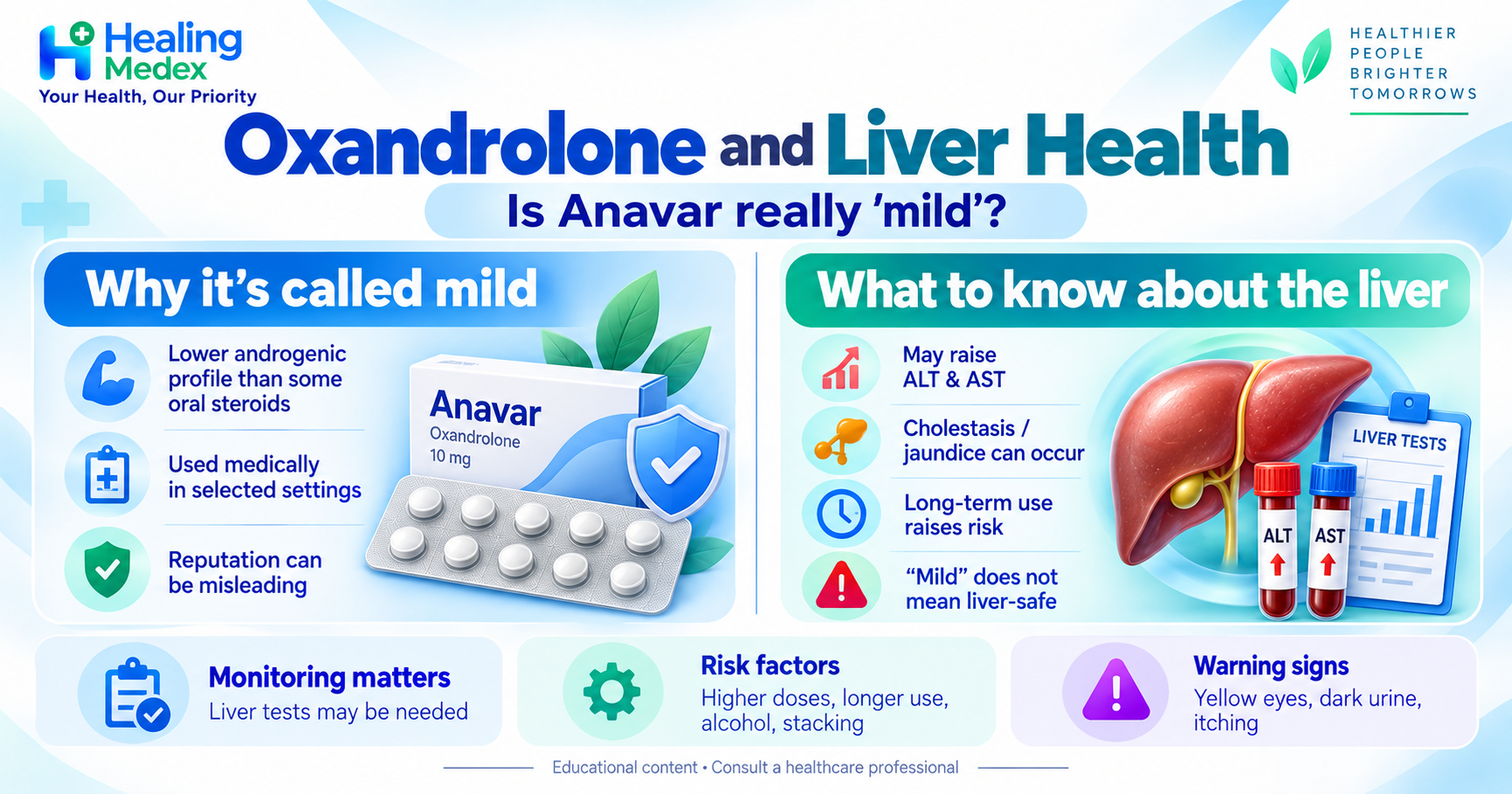
Oxandrolone, commonly known by the former brand name Anavar, is an anabolic-androgenic steroid (AAS). It has sometimes been described as a “mild” anabolic steroid because its androgenic effects are relatively lower than those of some other anabolic steroids and because medically supervised oxandrolone has been used in selected clinical settings.
However, “mild” does not mean harmless. Oxandrolone is an orally active 17-alpha-alkylated anabolic steroid, a chemical modification that allows it to survive first-pass metabolism in the liver. This same class of oral anabolic steroids is particularly associated with liver-related adverse effects.
So, how much risk does oxandrolone actually pose to liver health? Here is what the evidence shows.
What Is Oxandrolone?
Oxandrolone is a synthetic derivative of testosterone with anabolic and androgenic properties. Historically, it has been prescribed in certain medical circumstances involving severe weight loss, catabolic illness and recovery from major burns.
Its chemical structure allows oxandrolone to be taken orally and remain biologically active after passing through the liver.
Although earlier medical literature suggested that oxandrolone may have a more favorable safety profile than some other 17-alpha-alkylated anabolic steroids, liver abnormalities can still occur.
Why Is Oxandrolone Often Called a “Mild” Steroid?
Oxandrolone developed a reputation for being relatively mild because it has comparatively limited androgenic activity and, in supervised therapeutic studies, serious clinical liver injury has not been common.
That reputation can be misleading.
A medication may have a lower risk than another anabolic steroid without having a low absolute risk, particularly when it is used at non-medical doses, for prolonged periods, alongside other substances or without laboratory monitoring.
Clinical studies have documented elevations in liver enzymes during oxandrolone treatment. LiverTox notes that oxandrolone belongs to a steroid class associated with abnormal liver tests, cholestasis, peliosis hepatis and hepatic tumors.
How Can Oxandrolone Affect the Liver?
1. Liver Enzymes Can Increase
Oxandrolone can cause elevations in liver enzymes such as ALT and AST.
These laboratory changes may occur without obvious symptoms. In one clinical series involving patients treated with oxandrolone after significant burns, elevations in ALT or AST occurred in a substantial proportion of patients, although they were generally asymptomatic and transient.
More recent evidence in burn patients has also found higher rates of transaminase elevations among adults receiving oxandrolone compared with placebo.
An elevated liver enzyme result does not automatically mean permanent liver damage, but it can be an important sign that further medical assessment is needed.
2. Cholestasis and Jaundice Are Possible
One of the characteristic forms of liver injury associated with 17-alpha-alkylated anabolic steroids is cholestasis.
Cholestasis occurs when normal bile formation or bile flow from the liver becomes impaired.
Possible symptoms include:
Yellowing of the skin or eyes
Dark urine
Pale or unusually light stools
Severe itching
Loss of appetite
Nausea
Abdominal discomfort
Fatigue
Anabolic-steroid-associated cholestasis can sometimes be prolonged even after the steroid has been discontinued.
Regulatory labeling for oxandrolone specifically warns that cholestatic hepatitis and jaundice can occur with 17-alpha-alkylated androgens, including at relatively low doses.
3. Peliosis Hepatis Is a Rare but Serious Concern
Peliosis hepatis is an uncommon condition in which blood-filled cavities develop within liver tissue.
It has been reported in people receiving anabolic-androgenic steroids. In severe cases, the lesions may cause liver dysfunction or potentially dangerous internal bleeding.
Oxandrolone labeling has historically carried a warning regarding peliosis hepatis associated with androgenic-anabolic steroid therapy.
Although this complication is rare, it demonstrates why describing oral anabolic steroids as completely liver-safe is inaccurate.
4. Long-Term Exposure Has Been Associated With Liver Tumors
Long-term exposure to androgenic and anabolic steroids has been associated with hepatic tumors, including liver adenomas and, less commonly, malignant tumors.
The relationship is most strongly recognized with prolonged exposure to 17-alpha-alkylated anabolic steroids.
These complications are substantially different from temporary elevations in liver enzymes and emphasize the importance of duration and cumulative exposure when evaluating risk.
Is Oxandrolone Safer for the Liver Than Other Oral Steroids?
Oxandrolone has sometimes shown a more favorable hepatic safety profile under controlled medical conditions than certain other oral anabolic steroids.
For example, older clinical literature described transient enzyme elevations as more common than severe clinical liver injury during therapeutic oxandrolone use.
However, direct head-to-head evidence comparing liver toxicity among anabolic steroids is limited, and individual risk varies considerably.
It is therefore more accurate to say:
Oxandrolone may be less hepatotoxic in some circumstances than certain other oral anabolic steroids, but it is not non-hepatotoxic or liver-safe.
Medical Use and Non-Medical Use Are Not Equivalent
Safety information from clinical studies should not automatically be applied to bodybuilding or performance-enhancing use.
Medical therapy typically involves:
A defined clinical indication
Pharmaceutical-quality medication
Physician supervision
Defined treatment duration
Laboratory monitoring
Assessment of other medications and medical conditions
Non-medical anabolic steroid use can involve different exposure levels, longer durations, combinations of multiple steroids and uncertain product purity.
These differences can substantially alter risk.
What Can Increase the Risk of Liver Problems?
Liver risk may be greater when anabolic steroids are combined with additional factors that place stress on the liver.
Examples include:
Prolonged anabolic steroid exposure
Combining multiple oral anabolic steroids
Heavy alcohol consumption
Pre-existing liver disease
Taking other potentially hepatotoxic medicines or supplements
Unregulated bodybuilding products containing undisclosed ingredients
Repeated courses of anabolic steroids without medical monitoring
Bodybuilding supplements can also be problematic because some products have been found to contain anabolic steroids or other undeclared compounds. LiverTox notes that steroid-containing bodybuilding products have been implicated in severe and sometimes prolonged cholestatic liver injury.
Which Liver Tests May Be Checked?
When oxandrolone is prescribed medically, clinicians may periodically evaluate liver-related blood tests.
These can include:
ALT (alanine aminotransferase):
Often increases when liver cells are irritated or injured.
AST (aspartate aminotransferase):
Can rise with liver injury but may also increase following significant muscle damage or strenuous exercise.
Alkaline phosphatase (ALP):
Can provide information about the liver and bile ducts.
Bilirubin:
Elevated bilirubin may occur when bile processing or flow becomes impaired.
GGT (gamma-glutamyl transferase):
May provide additional information about hepatobiliary function.
Interpreting these tests individually can be misleading. A clinician normally assesses the overall pattern together with symptoms, medications, alcohol intake, exercise history and other laboratory findings.
Normal Liver Enzymes Do Not Guarantee That Everything Is Normal
One important misconception is that normal AST and ALT automatically prove that an anabolic steroid is causing no liver problems.
Certain forms of anabolic-steroid-induced liver injury, particularly cholestasis, can produce marked bilirubin elevation despite only modest increases in traditional liver enzymes.
Laboratory monitoring is therefore useful, but it cannot eliminate every potential risk.
What Symptoms Require Medical Attention?
Anyone exposed to oxandrolone or another anabolic steroid should seek medical assessment if symptoms suggesting liver dysfunction develop.
Important warning signs include:
Yellow eyes or skin
Very dark urine
Pale stools
Persistent or severe itching
Unexplained nausea or vomiting
Loss of appetite
Persistent pain in the upper-right abdomen
Significant unexplained fatigue
Abdominal swelling
Jaundice or severe abdominal symptoms should not simply be managed by adding supplements or attempting to “detox” the liver.
Do Liver-Support Supplements Prevent Oxandrolone Toxicity?
There is no supplement that makes oxandrolone or other hepatotoxic anabolic steroids reliably safe for the liver.
Products promoted as “liver protection” should not be considered substitutes for reducing exposure, appropriate medical assessment and laboratory monitoring.
Some supplements themselves can also cause drug-induced liver injury, making unsupervised combinations particularly difficult to evaluate.
Can the Liver Recover After Oxandrolone Is Stopped?
Many anabolic-steroid-associated liver abnormalities improve after the responsible drug is discontinued.
Transient enzyme elevations may normalize, and drug-induced cholestasis often eventually resolves. However, recovery from severe cholestasis can take weeks or months. Some complications associated with prolonged anabolic steroid exposure can potentially have longer-lasting consequences.
Recovery therefore depends on the type and severity of the injury rather than simply whether the steroid has been stopped.
Is Anavar Really “Mild” on the Liver?
The term “mild” needs context.
Oxandrolone has demonstrated a comparatively favorable safety profile in certain medically supervised populations, and severe liver toxicity does not occur in every patient. Nevertheless, it remains an orally active 17-alpha-alkylated anabolic steroid capable of altering liver tests and causing clinically important hepatic complications.
Calling Anavar “mild” should therefore never be interpreted as meaning liver-safe, risk-free or suitable for unsupervised use.
Key Takeaway
Oxandrolone may have a reputation as one of the milder anabolic steroids, but that reputation can underestimate its potential effects on the liver.
Oxandrolone can:
Increase liver enzymes
Produce cholestatic liver injury and jaundice
Rarely contribute to peliosis hepatis
Be associated with hepatic tumors during prolonged anabolic-steroid exposure
Produce liver abnormalities even when symptoms are initially absent
Anyone prescribed oxandrolone should follow the monitoring plan recommended by their healthcare professional. People using anabolic steroids without medical supervision should not assume that the absence of symptoms—or the label “mild”—means the liver is unaffected.