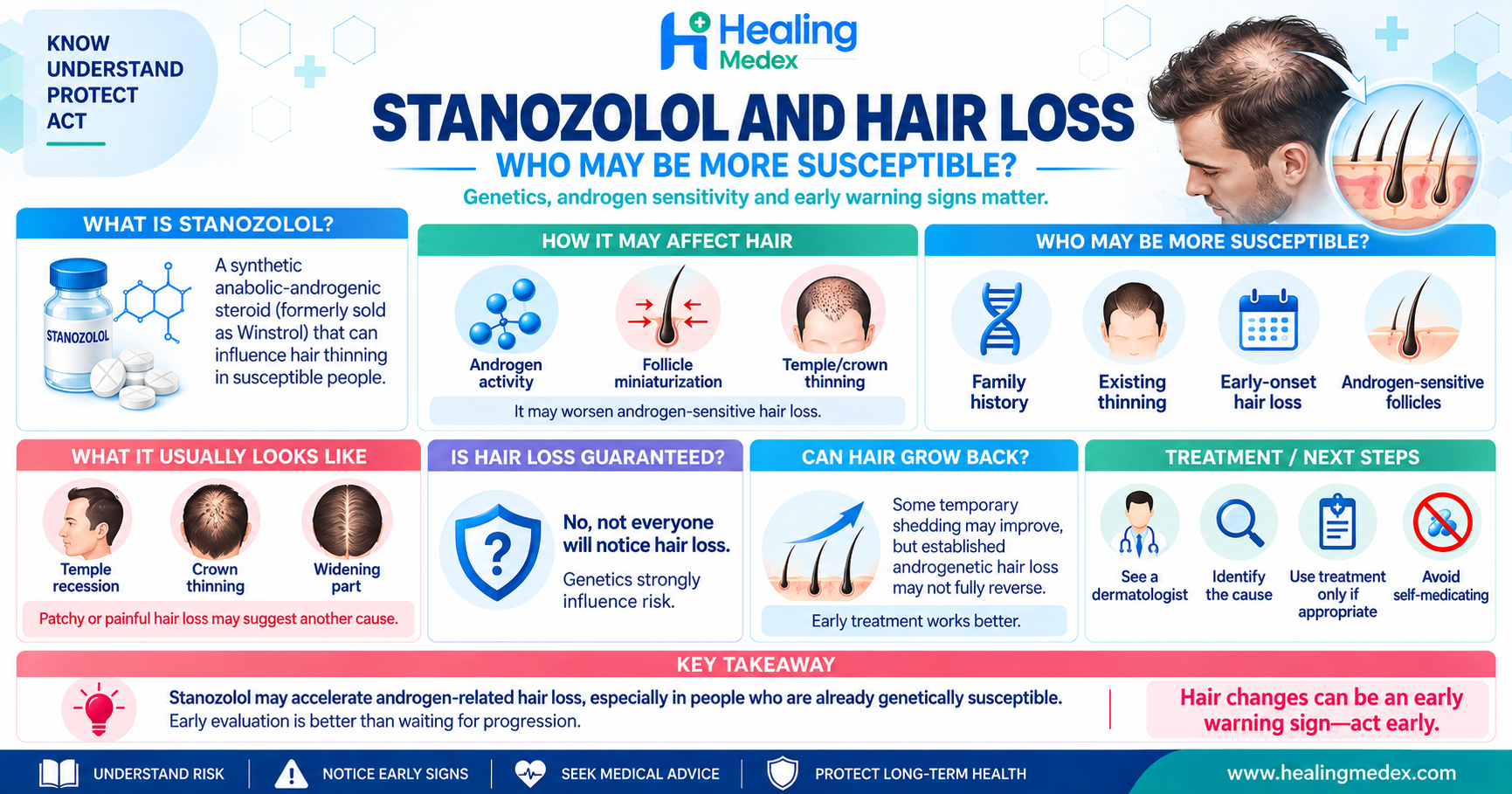
Stanozolol, commonly known by the former brand name Winstrol, is a synthetic anabolic-androgenic steroid (AAS). It has both anabolic and androgenic activity and is structurally related to dihydrotestosterone (DHT). Like other androgenic steroids, stanozolol can potentially contribute to androgen-related effects involving the skin and hair.
One concern among people exposed to anabolic steroids is scalp hair thinning or accelerated pattern hair loss. However, not everyone who uses an androgenic steroid develops noticeable hair loss. Genetic susceptibility, existing androgenetic alopecia, follicle sensitivity and other factors can significantly influence what happens.
Importantly, direct clinical research measuring the exact incidence of hair loss caused specifically by stanozolol is limited. Therefore, it is more accurate to say that stanozolol may accelerate androgen-sensitive hair loss in susceptible people rather than claiming that everyone who uses it will become bald.
How Could Stanozolol Affect Hair?
The most common form of progressive hair loss is androgenetic alopecia, often called male-pattern or female-pattern hair loss.
Androgenetic alopecia occurs when genetically susceptible scalp follicles respond excessively to androgen signaling. Over time, affected follicles become progressively smaller, producing shorter and thinner hairs until visible scalp thinning develops.
DHT normally plays an important role in this process. However, stanozolol is itself a DHT-derived, androgenically active steroid, so its effects cannot simply be understood by measuring natural testosterone or DHT levels. Stanozolol can influence androgen-responsive tissues through androgen-receptor-related pathways.
A 2025 review examining hair loss associated with testosterone and anabolic-androgenic steroid use in male athletes also identified androgenetic alopecia as a relevant hair-related concern among AAS users.
Who May Be More Susceptible to Hair Loss?
Some individuals are considerably more vulnerable to androgen-related hair thinning than others.
People with a strong family history of pattern baldness: Genetics is one of the strongest predictors of androgenetic alopecia. A 2026 systematic review and meta-analysis found that family history was significantly associated with both the presence and progression of androgenetic alopecia.
People who already have a receding hairline or thinning crown: Existing androgenetic alopecia means susceptible follicles are already undergoing miniaturization. Additional androgen exposure may potentially accelerate the process.
People who developed hair loss at a young age: Early-onset pattern hair loss may indicate substantial genetic and follicular sensitivity to androgens. Male-pattern hair loss can begin during the late teenage years or early twenties.
People with highly androgen-sensitive follicles: Individuals differ considerably in how their follicles respond to androgen signaling. Variations involving the androgen receptor and numerous other genes contribute to susceptibility.
People exposed to multiple androgenic substances: Combining anabolic-androgenic steroids increases overall hormonal exposure and makes it more difficult to determine which substance is responsible for a new adverse effect. Direct evidence quantifying the additional hair-loss risk of specific steroid combinations remains limited.
People with other background risk factors for androgenetic alopecia: Smoking has been associated with both the presence and progression of androgenetic alopecia, while factors including poor sleep, obesity and some metabolic abnormalities have been associated with disease progression in observational research. These factors are not specific to stanozolol.
What Does Stanozolol-Related Hair Loss Usually Look Like?
If androgen exposure accelerates androgenetic alopecia, hair loss generally follows the person's genetically determined pattern rather than causing random bald patches.
In men, this commonly involves recession around the temples, gradual thinning of the frontal scalp or thinning at the crown. In women, androgenetic alopecia more commonly produces diffuse thinning over the central scalp or widening of the part.
Someone may initially notice that the hairline looks slightly thinner in photographs, more scalp is visible under bright lighting or hairs around the temples become shorter and finer.
Sudden shedding across the entire scalp, sharply defined bald patches, inflammation, scaling or significant scalp pain may indicate another condition and should not automatically be blamed on stanozolol.
Is Hair Loss Guaranteed With Stanozolol?
No.
Androgen exposure alone does not determine whether someone develops noticeable pattern baldness. Genetics and follicular sensitivity are extremely important.
One person may experience substantial thinning while another exposed to similar androgen levels may notice little visible change.
This is why family history can provide useful information, although it cannot predict exactly what will happen to an individual. Androgenetic alopecia is now understood to be a complex, polygenic condition involving numerous genetic pathways rather than a single “baldness gene.”
Can Hair Grow Back After Stopping Stanozolol?
The answer depends on what caused the hair loss and how advanced follicular miniaturization has become.
Temporary shedding related to physiological stress may improve after the underlying trigger resolves. Established androgenetic alopecia behaves differently. Once susceptible follicles have progressively miniaturized, spontaneous complete recovery cannot be assumed.
Stopping an androgenic trigger may reduce continued exposure, but it does not guarantee restoration of lost hair.
Early evaluation is therefore important. The American Academy of Dermatology notes that treatment of hereditary hair loss tends to work better when started earlier.
Does Finasteride Prevent Hair Loss From Stanozolol?
Finasteride is an established treatment for male androgenetic alopecia. It works by inhibiting type-2 5-alpha-reductase, thereby reducing the conversion of testosterone into DHT.
Stanozolol creates an important distinction.
Stanozolol is already a 17α-alkylated derivative of DHT rather than testosterone that needs to be converted into DHT by 5-alpha-reductase.
For that reason, people should not assume that taking finasteride will reliably protect their hair from androgenic effects associated with stanozolol. There is insufficient clinical evidence showing that finasteride specifically prevents stanozolol-associated hair loss.
Finasteride also has contraindications and potential adverse effects, so it should not be self-prescribed simply to counteract steroid-related hair changes.
What About Minoxidil?
Topical minoxidil is one of the established treatments for androgenetic alopecia and is used to help maintain or improve hair growth in appropriate patients.
However, using a hair-loss treatment does not make anabolic-steroid exposure medically safe, nor can it guarantee prevention of androgen-related follicle miniaturization.
Anyone experiencing new or rapidly progressing hair loss should first establish the cause rather than automatically starting several hair-loss medications.
When Should You See a Dermatologist?
Medical evaluation is particularly useful when hair loss is progressing rapidly, begins soon after starting a new medication or hormone, occurs in patches, or is accompanied by itching, redness, scaling or scalp pain.
A dermatologist can distinguish androgenetic alopecia from other causes such as telogen effluvium, alopecia areata, nutritional deficiencies, thyroid disorders and inflammatory scalp disease.
The American Academy of Dermatology emphasizes that many conditions can cause hair loss and that identifying the underlying cause is important for selecting appropriate treatment.
Hair Loss Is Not the Only Health Concern
Hair changes may be cosmetically significant, but they should not distract from the broader health risks associated with non-medical anabolic-androgenic steroid use.
Stanozolol is a 17α-alkylated anabolic steroid, a class particularly associated with liver toxicity. Androgenic steroids have been linked to cholestatic liver injury and, with prolonged exposure, more serious hepatic complications.
Other AAS-related concerns can involve cholesterol, cardiovascular health, reproductive hormones and skin. Anyone using anabolic steroids without medical supervision should understand that taking additional medicines simply to control individual side effects does not eliminate these broader risks.
The Bottom Line
Stanozolol may contribute to or accelerate androgen-related scalp hair loss, particularly in people who are already genetically susceptible to androgenetic alopecia.
The people most likely to notice problems include those with a strong family history of baldness, an already receding hairline or thinning crown, early-onset pattern hair loss, or follicles that are particularly sensitive to androgen signaling.
At the same time, direct studies establishing exactly how often stanozolol causes hair loss are limited. Not everyone exposed to stanozolol will experience noticeable thinning, and the degree of hair loss cannot be predicted reliably from dose or family history alone.
If hair thinning develops during anabolic-steroid exposure, early assessment by a dermatologist is preferable to assuming the cause or self-treating with medications such as finasteride.