Testosterone cypionate and testosterone enanthate are two of the most widely used injectable forms of testosterone replacement therapy (TRT). Because both are long-acting testosterone esters, they have many similarities—and the differences between them are often smaller than people expect.
Both medications ultimately deliver testosterone to the body. Their attached ester helps slow the release of testosterone after injection, allowing the medication to remain active longer than unmodified testosterone.
So, is testosterone cypionate better than testosterone enanthate? Does one last longer? And are their side effects different?
This article explains the key medical differences between testosterone cypionate vs testosterone enanthate, including how they work, how long they act, available formulations, potential side effects, and what patients should discuss with their healthcare provider.
Important: Testosterone is a prescription medication and should be used only after appropriate medical evaluation. This article is for educational purposes and does not provide an individualized treatment or dosing plan.
What Is Testosterone Replacement Therapy?
Testosterone replacement therapy may be prescribed to men who have clinically confirmed testosterone deficiency caused by certain medical conditions.
A diagnosis of hypogonadism should not be based on symptoms alone. The Endocrine Society recommends confirming testosterone deficiency in men who have compatible symptoms together with consistently low testosterone concentrations, typically using repeated morning testosterone measurements.
Testosterone replacement can be administered through several formulations, including:
Intramuscular injections
Subcutaneous injections
Gels
Patches
Nasal preparations
Other approved testosterone formulations
Testosterone cypionate and testosterone enanthate are among the commonly used injectable options.
What Is Testosterone Cypionate?
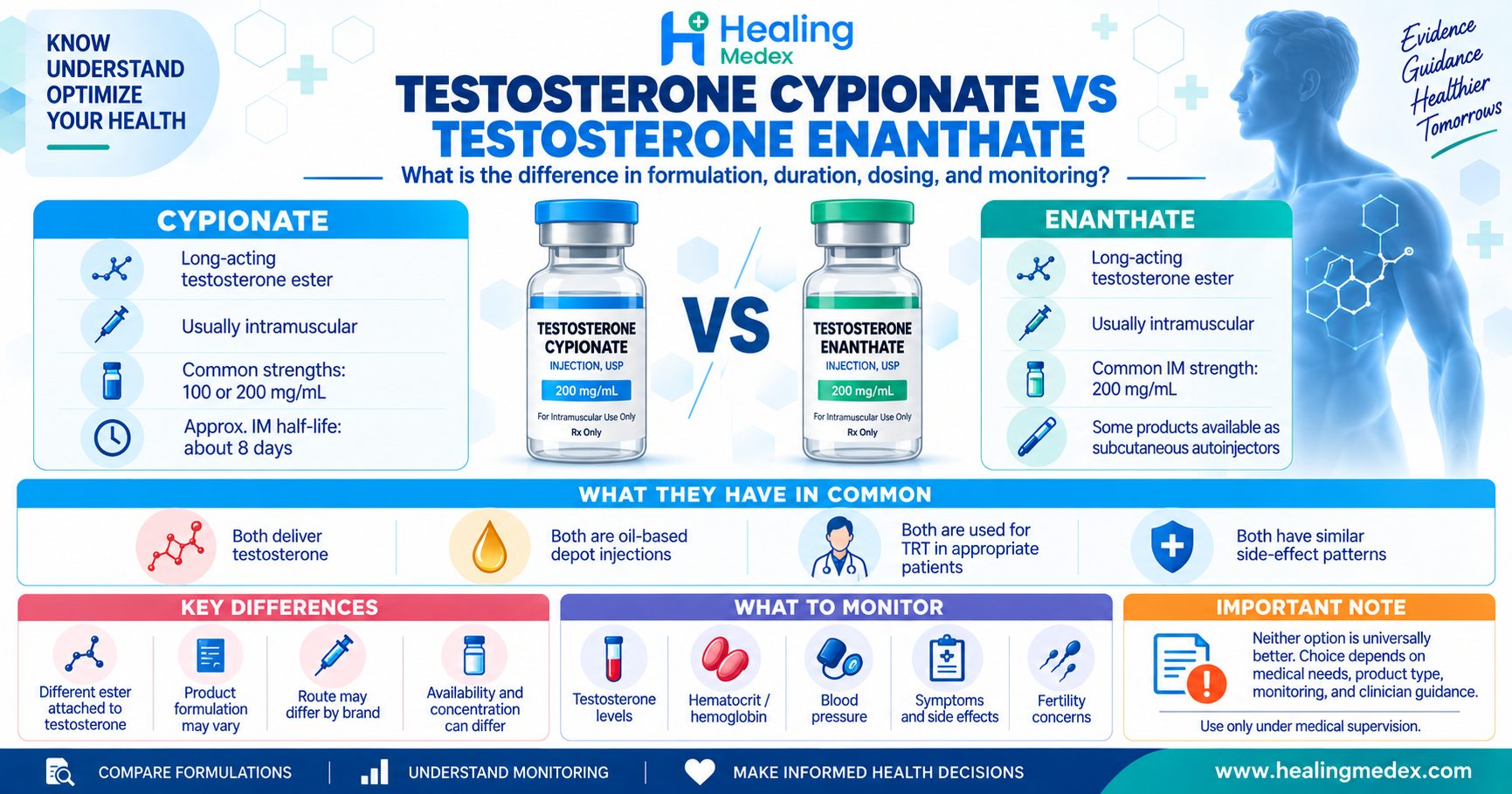
After an intramuscular injection, the medication forms a depot from which testosterone cypionate is gradually absorbed. The ester is subsequently separated from the molecule, releasing active testosterone into the circulation.
Current U.S. labeling describes testosterone cypionate as an oil-soluble testosterone ester intended for intramuscular administration. Its estimated intramuscular half-life is approximately eight days.
Depending on the manufacturer, testosterone cypionate products may be supplied in concentrations such as 100 mg/mL or 200 mg/mL.
What Is Testosterone Enanthate?
Testosterone enanthate is another esterified, long-acting form of testosterone.
Like cypionate, esterification slows testosterone release after injection. Standard testosterone enanthate injection products are oil-based and may be administered intramuscularly.
For example, current U.S. testosterone enanthate labeling includes a 200 mg/mL intramuscular formulation containing testosterone enanthate in sesame oil.
There is also an FDA-approved testosterone enanthate product called XYOSTED that uses a subcutaneous autoinjector, showing that the route of administration can depend on the specific product rather than simply the testosterone ester itself.
Testosterone Cypionate vs Enanthate: Quick Comparison
Feature | ||
|---|---|---|
Active hormone | ||
Ester | Cypionate | Enanthate |
Duration | Long acting | Long acting |
Common formulation | Oil-based injection | Oil-based injection |
Common route | Intramuscular | Intramuscular; some products are subcutaneous |
Typical concentration | Often 100 or 200 mg/mL | Commonly 200 mg/mL for IM products |
Release pattern | Gradual | Gradual |
Main medical purpose | Testosterone replacement in appropriately diagnosed patients | Testosterone replacement in appropriately diagnosed patients |
Side-effect profile | Very similar | Very similar |
Controlled medication in U.S. | Schedule III | Schedule III |
Both intramuscular testosterone cypionate and testosterone enanthate labels describe dosing intervals extending into the two-to-four-week range, although actual treatment schedules must be individualized according to the product, blood tests, clinical response, and prescriber instructions.
1. The Main Difference Is the Ester
The primary chemical difference is the ester attached to the testosterone molecule.
Testosterone cypionate contains a cypionate ester, while testosterone enanthate contains an enanthate ester.
The ester itself is not responsible for testosterone's main androgenic effects. Instead, it changes characteristics such as how slowly the injected medication leaves the oil depot and becomes available.
Once the ester is removed inside the body, both ultimately provide active testosterone.
For most patients receiving medically supervised TRT, this means their overall physiological actions are highly similar.
2. Does Testosterone Cypionate Last Longer Than Enanthate?
Testosterone cypionate and testosterone enanthate are both considered long-acting testosterone preparations.
U.S. labeling for testosterone cypionate reports an intramuscular half-life of approximately eight days.
Standard testosterone enanthate labeling similarly describes slow absorption from an intramuscular oil depot and states that the medication can be administered at extended intervals.
Although pharmacokinetic differences between the two esters exist, they are generally more similar than different in routine clinical use.
Individual testosterone levels can also vary considerably depending on:
Dose
Injection interval
Route of administration
Metabolism
SHBG levels
Age
Body composition
Timing of blood tests
For this reason, treatment decisions should be guided by laboratory monitoring and symptoms rather than assuming one ester will automatically provide better or more stable testosterone levels.
3. Are Their Injection Schedules Different?
Not necessarily.
Current U.S. prescribing information for both traditional intramuscular testosterone cypionate and testosterone enanthate includes replacement-therapy dosing ranges administered at intervals of approximately two to four weeks.
However, these label ranges should not be interpreted as a personal treatment schedule.
A clinician may adjust treatment based on factors such as:
Testosterone blood levels
Clinical response
Hematocrit
Adverse effects
Age
Underlying cause of hypogonadism
Specific testosterone product being used
Patients should not independently increase doses, shorten injection intervals, or switch testosterone preparations.
4. Is One More Effective for Low Testosterone?
When testosterone concentrations are maintained within an appropriate physiological range, either formulation may help improve symptoms related to genuine testosterone deficiency.
Potential improvements in appropriately selected patients may include changes in:
Sexual function
Libido
Energy
Lean body mass
Bone health
Certain symptoms associated with testosterone deficiency
There is no simple medical rule stating that testosterone cypionate is universally more effective than testosterone enanthate or vice versa.
Treatment response depends substantially more on appropriate diagnosis, dose selection, monitoring, and individual physiology.
5. Do They Produce Different Testosterone Levels?
Both preparations can produce rises and falls in testosterone after an injection.
Injectable testosterone is absorbed gradually from the injection site, but serum concentrations can still fluctuate between doses.
How significant those fluctuations become depends on the formulation and treatment schedule.
A patient experiencing symptoms before the next scheduled injection should discuss them with their clinician rather than changing the schedule without medical supervision.
Blood testing can help determine whether testosterone exposure is appropriate.
6. Do Cypionate and Enanthate Have Different Side Effects?
Their side-effect profiles overlap substantially because the active hormone produced by both formulations is testosterone.
Potential effects associated with testosterone therapy can include:
Acne or oily skin
Increased red blood cell production
Increased hematocrit
Fluid retention
Gynecomastia
Changes in libido
Changes in cholesterol
Injection-site discomfort
Suppression of natural testosterone production
Reduced sperm production
Potential worsening of sleep apnea in susceptible individuals
Testosterone products have also been associated with venous thromboembolic events, including deep-vein thrombosis and pulmonary embolism.
The exact risk profile varies by patient and formulation.
7. Can Testosterone Raise Hematocrit?
Yes.
Testosterone stimulates red blood cell production. In some people, this can cause hematocrit to rise excessively—a condition sometimes described as testosterone-associated erythrocytosis or polycythemia.
For this reason, hematocrit is an important laboratory value during testosterone therapy.
Current testosterone labeling recommends checking hematocrit before treatment and monitoring it during therapy.
Very high hematocrit may require adjustment or interruption of treatment by the prescribing clinician.
8. Can Testosterone Affect Blood Pressure?
Testosterone products can increase blood pressure in some patients.
Current testosterone prescribing information advises periodic blood-pressure monitoring, particularly in patients who already have hypertension.
People with cardiovascular risk factors should discuss them with their healthcare provider before beginning testosterone replacement.
9. Can Testosterone Cypionate or Enanthate Affect Fertility?
Yes.
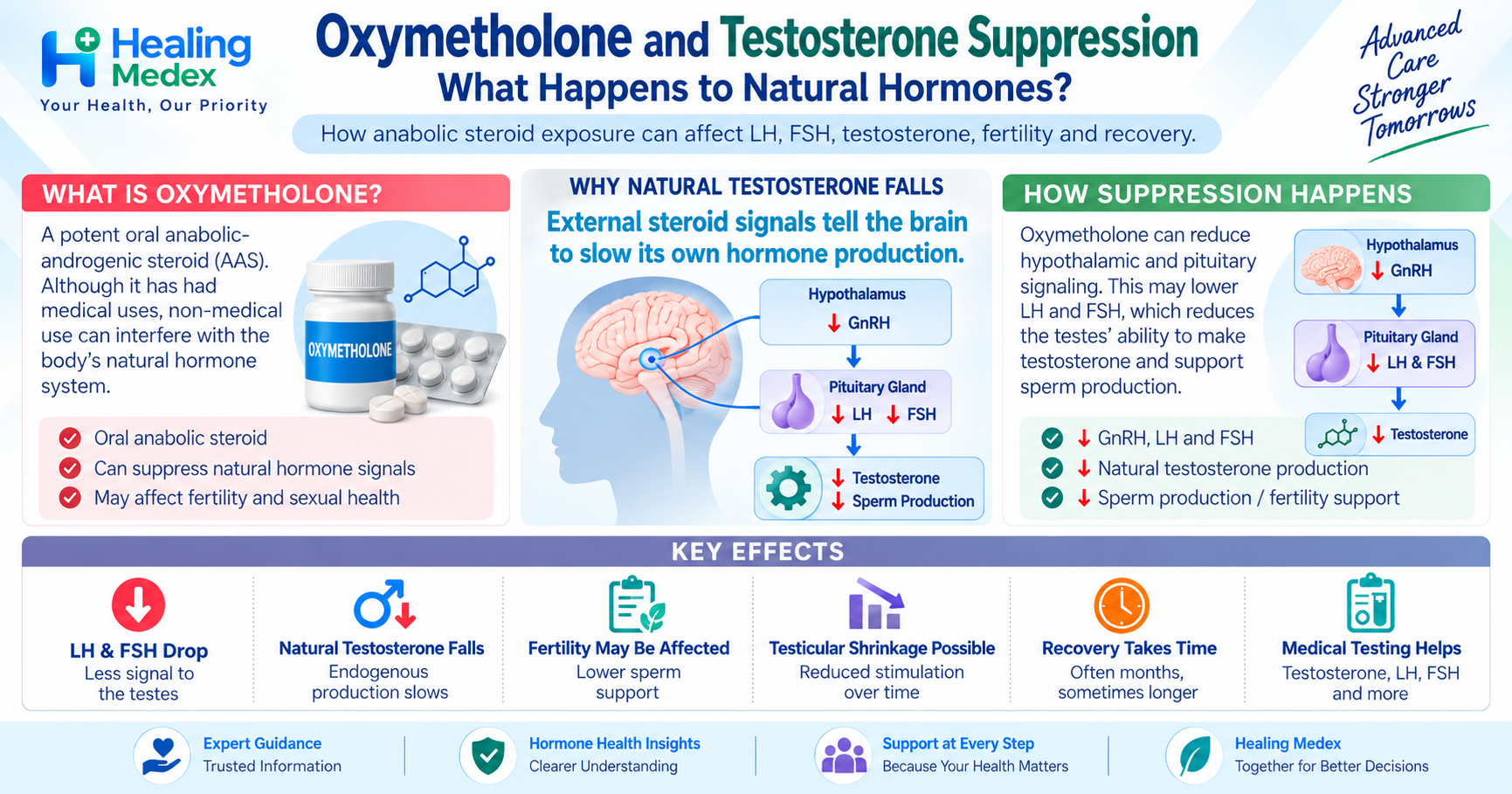
An important but sometimes overlooked effect of testosterone replacement therapy is suppression of the body's reproductive hormone signaling.
External testosterone can reduce secretion of luteinizing hormone and follicle-stimulating hormone, which may reduce testosterone production inside the testes and impair sperm production.
Testosterone therapy can therefore cause:
Reduced sperm count
Oligospermia
Azoospermia
Reduced fertility
Current testosterone enanthate labeling specifically warns that exogenous androgens may negatively affect spermatogenesis.
The Endocrine Society recommends against beginning testosterone therapy in men who are planning fertility in the near future.
Anyone hoping to conceive should tell their clinician before starting TRT.
10. What Monitoring Is Needed During TRT?
Testosterone replacement should not be treated as a medication that can simply be started and forgotten.
Monitoring may include evaluation of:
Testosterone Levels
Blood testing helps determine whether testosterone concentrations are in an appropriate therapeutic range.
Hematocrit and Hemoglobin
These tests help identify excessive red blood cell production.
Blood Pressure
Testosterone can increase blood pressure in some individuals.
Prostate Health
Depending on age and individual risk factors, prostate-related evaluation may be appropriate.
Treatment Response
Clinicians should assess whether symptoms are actually improving.
Adverse Effects
Acne, edema, urinary symptoms, sleep apnea symptoms, fertility concerns, and other adverse effects should be reviewed.
The Endocrine Society recommends evaluating patients after starting therapy to determine clinical response, adverse effects, and adherence.
Testosterone Cypionate vs Enanthate: Which Is Better?
There is no universally superior option.
For medically supervised testosterone replacement, cypionate and enanthate are closely related medications that ultimately provide the same active hormone.
The most suitable preparation may depend on:
Product availability
Route of administration
Formulation ingredients
Cost
Insurance coverage
Injection preferences
Previous response
Adverse effects
Clinician experience
Local regulatory approval
Someone who responds well to one formulation may have little reason to switch simply because another ester is promoted as being “better.”
Is Testosterone Enanthate Available as a Subcutaneous Injection?
Yes, depending on the specific product.
Traditional testosterone enanthate preparations are administered intramuscularly. However, XYOSTED is an FDA-approved testosterone enanthate autoinjector designed for subcutaneous administration.
It is available in 50 mg, 75 mg, and 100 mg single-dose autoinjectors in the United States.
Patients should therefore follow the instructions for their exact medication rather than assuming all testosterone enanthate products are injected the same way.
What About Testosterone Use for Bodybuilding?
Prescription testosterone is intended for specific medical conditions, not unsupervised bodybuilding or performance enhancement.
Taking testosterone at higher-than-prescribed doses or combining it with other anabolic-androgenic steroids may substantially increase health risks.
Reported complications associated with anabolic-androgenic steroid misuse include cardiovascular problems, fertility impairment, abnormal cholesterol, testicular atrophy, psychiatric effects, and other serious adverse outcomes.
Both testosterone cypionate and testosterone enanthate are Schedule III controlled substances in the United States.
Frequently Asked Questions
1. Is testosterone cypionate stronger than testosterone enanthate?
Not in a meaningful general sense. Both are esterified forms of testosterone that release active testosterone after administration. Treatment effectiveness depends more on achieving appropriate testosterone exposure than simply choosing one ester over another.
2. Which lasts longer: testosterone cypionate or enanthate?
Both are long-acting injectable testosterone esters. Testosterone cypionate has an approximately eight-day intramuscular half-life according to prescribing information, while testosterone enanthate is also slowly absorbed from its oil depot. Their practical duration of action is broadly similar.
3. Can you switch from testosterone enanthate to cypionate?
A healthcare professional can switch testosterone formulations when appropriate, but patients should not perform a milligram-for-milligram substitution themselves. Concentration, route, dosing schedule, blood levels, and the characteristics of the specific product need to be considered.
4. Do both forms suppress natural testosterone?
Yes. External testosterone can suppress the hypothalamic-pituitary-gonadal axis, reducing the body's own testosterone and sperm production.
5. Can testosterone injections cause infertility?
They can significantly reduce sperm production in some men. Testosterone therapy is therefore generally inappropriate for men actively trying to conceive unless their reproductive specialist recommends another approach.
6. Can testosterone increase red blood cells?
Yes. Increased hematocrit is a recognized effect of testosterone treatment and requires monitoring.
7. Is testosterone cypionate safer than testosterone enanthate?
Neither is inherently risk-free. Because both ultimately deliver testosterone, many of their important risks overlap. Safety depends on appropriate patient selection, dosing, monitoring, underlying health conditions, and correct use.
The Bottom Line
Testosterone cypionate and testosterone enanthate are much more alike than they are different.
Both are long-acting testosterone esters designed to provide sustained testosterone exposure. Their main difference is the chemical ester attached to testosterone, along with product-specific differences such as formulation, concentration, carrier oil, injection route, and availability.
For patients with confirmed testosterone deficiency, either formulation may be appropriate when prescribed and monitored by a qualified healthcare professional.
Choosing between them should not be based on bodybuilding claims or assumptions that one ester is automatically stronger. The more important factors are obtaining an accurate diagnosis, selecting an appropriate formulation, monitoring testosterone and hematocrit, evaluating blood pressure and other risk factors, and adjusting treatment according to clinical response.
Anyone considering testosterone therapy—especially someone who wants to preserve fertility or has cardiovascular, prostate, sleep-apnea, or blood-pressure concerns—should discuss those issues with a healthcare professional before treatment.